Skip to content

Posts from the ‘International Intrigue’ Category

Sunday Night Special: Pad Prik King

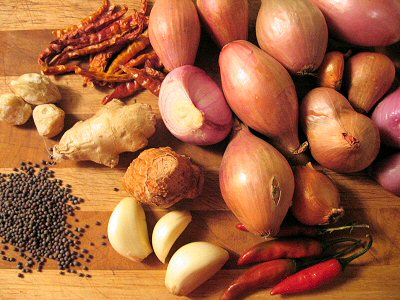
I recently occured to me that the only cooking I ever document is what I do on Sundays. That's simply because Sunday night is the only evening when I have the time and energy Prikkingfixingsfor silly crap like snapping photos of ingredients and typing up ingredient lists. Why fight it? I'm starting a new category: Sunday Night Special. The following recipe is from last Sunday, not today. I don't ever actually post anything in real time–I tend to mull things over, but mostly I'm just lazy. Let's see if the fish curry I plan to embark on in a hour or so ever makes it up here or not.
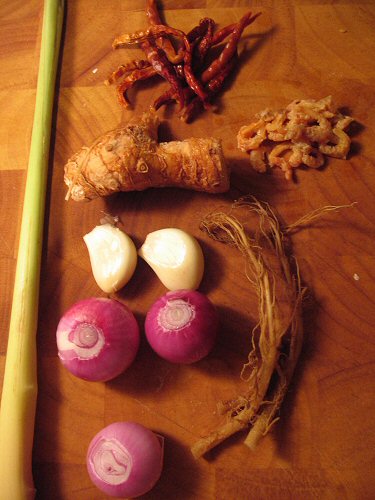
I never see cilantro with the roots intact, so when I found a dirt-caked pile of rooty herbs at Western Beef, I bought some with the primary intent of cutting, cleaning and saving the roots for later use in Thai recipes that always seem to call for them when I'm empty-handed. (Last week, for the first time, I saw rau ram, a.k.a. laksa leaves at Hong Kong Supermarket in Sunset Park. But I wasn't sure how well they'd hold up in the freezer and I didn't have any plans for any Malaysian recipes in the immediate future, so I was forced to pass.)

I decided to make a dry curry using pork and long beans David Thompson's paperback Thai cookbook from the early '90s, not the encyclopedic behemoth, Thai Cooking, that dazzled everyone a few years ago. I love that obsessive tome, but for a simple every day recipe, the smaller book usually suffices. I followed it fairly closely, though I didn't de-seed my chiles and used short ribs (I thought I had pork belly in the freezer, but I couldn't find it) primarily because I don't have a cleaver to chop down big ribs.
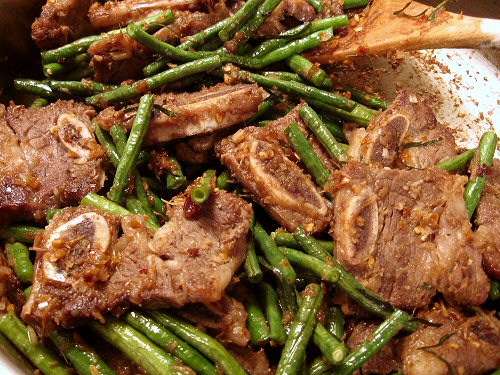
Padprikking The result was very strong and rich, though not from coconut milk. I guess the ingredients were naturally rich. I tried a canned prik khing paste last night for a similar recipe and thought the one from scratch was superior (though James seemed to like the prepared sauce better, but that's psychological because he bought the can)  I think even the good canned pastes, end up being too salty and flat. The freshly pureed paste was also considerably hotter than the canned version, which I had to spruce up with a couple chopped chiles.

Pork with Snake Beans and Chile Paste
Pad Prik King Tua Fak Yaew

2 tablespoons safflower oil or 4 tablespoons if using pork ribs or leg
2 cloves garlic, crushed
7 ounces pork belly, fresh bacon or pork ribs or leg, steamed and sliced into smalls strips
3 tablespoons of the chile paste
2 tablespoons fish sauce
1 tablespoon white sugar
2 ounces snake beans, cut into 1 ¼" lengths
6 kaffir lime leaves, shredded
3 fresh large red chiles, halved and deseeded

Chile Paste
5-10 dried red long chiles, deseeded and chopped
3 red shallots, chopped
2 cloves garlic
½ stalk lemongrass, sliced
1 teaspoon galangal, peeled and chopped
3 cilantro roots
1 tablespoon dried shrimp, rinsed
1 teaspoon salt

In a medium pan, heat the oil, add the garlic and fry until golden. Add the pork and fry until it begins to color. Add the chile paste and fry for about 5-8 minutes or until fragrant; if necessary, moisten with a little water to prevent the paste from sticking. Add the fish sauce and sugar. Mix in the beans, kaffir lime leaves and chiles, fry for another 2-3 minutes, or until the beans are cooked. It will taste quite rich and spicy.

To make chile paste, puree all the ingredients in a food processor (or mortar and pestle), using as little water as possible, until fine.

Adapted from Classic Thai Cuisine by David Thompson. Ten Speed Press. 1993.

Here's a fun site with Thai cooking videos. Watch stir-fried pork with long beans being made (scroll down to #9). They're not scared of MSG in Thailand.

I Heart Swad

I used to think Patak's was the shit, but then I got wise to Swad. Perhaps this brand is the Kraft of India, I don't know, but they do seem to manufacture every food product you could ever want–from chickpea flour to ready to eat meals (better than the ubiquitous Tasty Bite boxes that are probably getting more popular in the city thanks to Trader Joe's). And it's all packaged so sensibly with both Hindi and English terms and a large color photo.

GingergarlicOne of my most favorite products, and not just in the Swad canon, is something called Far Far Coloured (more generically, I think they're called farfar or wafers). At least on a visual level. I'm not sure about taste as I haven't attempted cooking mine yet. It looks like rainbow colored pasta, but if I'm correct you deep fry it. There aren't any directions on the bag. The only place I've seen a before and after preparation pic is an egullet post.

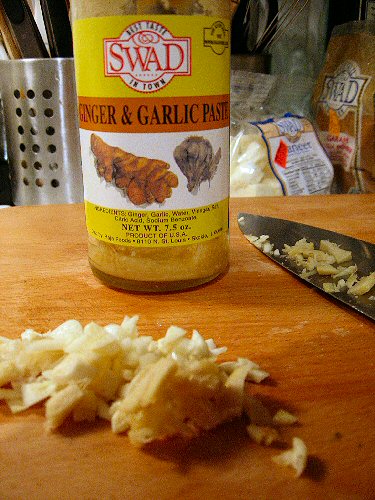
I go nuts buying Swad whenever I hit Patel Brothers (do note the Swad logo watermark on this site) in Jackson Heights. Canned, boxed, bagged, jarred, frozen, I covet all of it. You can use as little or as much Swad as you'd like. I don't usually feel like making cheese from scratch, and sometimes I'm not up for toasting and grinding spices. Mincing garlic and ginger isn't a problem for me, but if that's too much you can buy the essential combo in a jar. I keep it on hand just in case. Same goes for frozen items like bird chiles that aren't easy to find in Carroll Gardens, or more obscure vegetables like drumsticks. Fresh spinach is fine, but I love Swad's tidy ziplocked palak that comes pureed in little blocks ready to cook with.

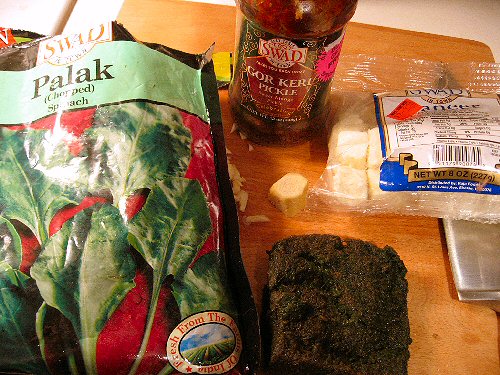
Palakfixings Last night I made a lazy palak paneer, which I'm sure would make purists cry, but I'm not anal about Indian cooking they way I am with S.E. Asian dishes. Essentially, I cooked down onion, garlic and ginger then added garam masala, a few hot pepper flakes, then tossed in a bag of spinach with cheese cubes following soon after. I splashed in a little half and half, as it was the only creamy thing in the house. Really, you should make your spice blend and brown the cheese separately. And the whole thing ends up as a rich ghee-filled amalgam. Instead, I used canola oil and raw cheese, as I'm trying to watch the rampant fat. It wasn't half-bad, but more vegetable forward and less like creamed spinach.

I used Swad brand paneer, garam masala, palak and mango pickle. Unfortunately, I was all out of Swad radish-stuffed naan. A nice Swad gulab jamun would've been the perfect nightcap, but I had to settle on a quarter tub (I actually managed to only eat one serving) of Ben & Jerry's Turtle Soup, which was kind of boring for that genre of ice cream. I like more crap in my frozen desserts.

Groundnuts, Pilli Pilli and Yams, Oh My

FufuI’ve always wondered why there wasn’t more written about African food. I guess South America doesn’t get a ton of ink either, but Buenos Aires is trendy these days. Even all those random (to me) countries like Montenegro, Estonia and “The Stans” (Uzbeki, Tajiki, etc.) seem to be popping up more and more. But Africa? Not so much. And it’s not as if I have any wisdom to impart, that’s why I want to know more about what they eat, and not just Morocco or South Africa. I mean, Africa contains 54 countries so there’s got to be something good in there.

That’s why I was glad to see ”A Taste of Ghana” in this week’s New York Times (interestingly, it’s currently the fourth most emailed article—New Yorkers want more African food!). Also, Robert Sietsema’s “Foo-foo Fundamentals” in October’s Gourmet. Gourmet doesn’t put much of anything online, but it’s an article about traveling around the U.S. and trying African restaurants. I don’t have the story on me, but I recall he went to D.C. and Texas, among other places. Ok, that’s only two major publications, but it’s something.

NYC has a smattering of Ethiopian restaurants and that Senegalese strip on 116th St., but I plead ignorance on much else. I think I have a preconceived notion that much of the food will be bland and stewy, which is likely false. I’d better get out there and find out.

Wanton Wontons

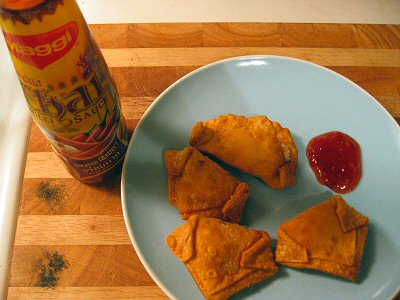
Rangoon_1 Crab rangoon is something I seem to indulge in when no one else is around. I think it's because I'll eat an entire $3.25 order of ten in one sitting and that's not the sort of thing to brag about. I just can't help it, rangoons are that good. Jalapeño poppers are second.

I needed roast pork on Christmas for a recipe and thought it would be the perfect excuse to have crab rangoon delivered. But I must admit Wing Hua's version were way too thick and chewy. It's not like I expect subtlety or perfection from a corner take out joint, but a rangoon should be at least a little crispy.

I survived, and for me rangoons are really a vehicle for sweet chile sauce. I picked up a few bottles of Maggi chile sauce in Singapore and I put it on everything I can. Versions of this sauce come in little plastic packets at fast food chains all over S.E. Asia. I had it at Burger King in Thailand and A&W and KFC in Malaysia. Great for dipping fries.

Devil of a Time

Devilfixings_1 I wanted to make a curry from scratch to while away a potentially dull Christmas evening. I was limited to what I could forage in my pantry, freezer and mediocre local grocery store on Christmas Eve, but I did alright. Weirdly, the only thing I needed to leave the house for was potatoes, though I ended up buying a fresher piece of ginger, the world's saddest stalk of lemongrass and chicken drumsticks and thighs rather than trying to chop up the whole bird I had frozen. While not ideal, I keep galangal, candlenuts, birdseye chiles and shredded lemongrass (as well as curry, pandan, banana and kaffir lime leaves) in the freezer for situations such as this.

Originally, I was leaning towards Thailand for inspiration, then remembered devil curry a supposed Eurasian Christmas dish. I say supposed because this isn't a cuisine I've experienced it first hand (though I have tried Macanese food). It's not like Kristang culture, the Portuguese-Malay mix centered around Malacca, is exactly booming (I think I'm just partial because my name, Krista, is in the word). They're a dying breed, literally.

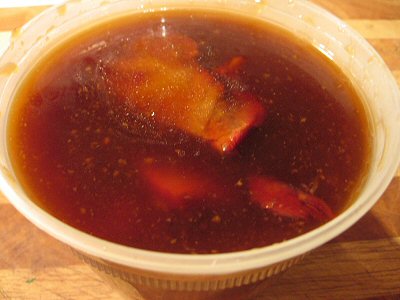
I found countless variations of devil curry in cookbooks and on the web. Nyonyas tend to add Roastpork_1 shrimp paste and cabbage, Singaporeans use tomato, cucumber and chicken cocktail franks (at first, I figured this was a Muslim adaptation– in Kuala Lumpur I had a morning choice of beef bacon, turkey ham and chicken sausage–but the char siew kind of throws off that theory). I actually had a can of Vienna sausages on hand, but didn't feel the urge to include them, authenticity be damned. I wouldn't have bothered with the Chinese roast pork, except that including it was an excuse to have crab rangoon delivered. However, the sliced meat came completely submerged in a gloppy brown sauce (pictured, right) that I had to strain off.

I settled on a fairly simple version from Eurasian Favorites by Wendy Hutton and added a teaspoon each of shrimp paste and tumeric powder (the root is one thing I've forgotten to keep in the freezer) because those extra ingredients seemed important.

Chicken Curry Devil (Curry Debal)
1 2 ½ pound fresh chicken, cut into bite-sized portions
1 tablespoon black soy sauce
½ cup oil
2 medium onions, quartered
3 cups water
2 stems lemongrass, bruised
1 ½ teaspoons salt
8 ounces Chinese roast pork, cut into ¾" pieces (optional)
3 potatoes, peeled and quartered
2 tablespoons vinegar
2 teaspoons sugar
1 teaspoon hot English mustard powder

Spice Paste
2 teaspoons brown mustard seeds
12-16 dried chiles, cut in ¾" lengths, soaked to soften
4 large red chiles, sliced
14 shallots, chopped
2 tablespoons garlic, chopped
2 tablespoons ginger, chopped
1 tablespoon galangal, finely chopped
3 candlenuts, chopped

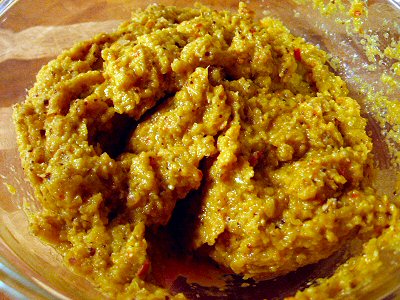
Devilpaste_1 1. Prepare the spice paste by processing mustard seeds in spice grinder until coarsely ground. Add both lots of chiles, shallots, garlic, ginger, galangal and candlenuts and blend to a smooth paste, adding a little of the oil if necessary to keep blades turning.

2. Put 4 tablespoons of the spice paste and the soy sauce in a large bowl and stir to mix well. Add chicken and stir to coat with the mixture.

3. Heat a wok, add ¼ cup of the oil and heat until very hot. Add marinated chicken and stir-fry until it changes color all over, 3-4 minutes. Remove chicken pieces. Add remaining oil, reduce heat and stir-fry remaining spice paste and quartered onions over low-medium heat for 4-5 minutes.

4. Add water, lemongrass and salt and simmer 2 minutes, scraping any spice paste from the bottom. Add chicken, cover the wok and simmer, stirring occasionally, for 10 minutes. Add roast pork, if using, and potatoes and simmer until cooked, about 20 minutes, stirring occasionally. Mix vinegar, sugar and mustard, then add to the wok, stirring for about 1 minute to mix well.

5. Transfer to a large bowl and serve with steamed white rice.

Serves 4

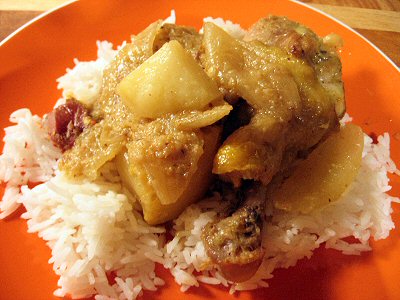
Devilcurry_1 The end result was spicy, but not as hot as I'd anticipated. I'm betting that the devil curry will taste even better tomorrow. Especially since I used hotter chiles than the recipe called for. I can never find long red peppers like Holland chiles. But the curry definitely had that Malaysian quality, which I think comes from the belacan, candlenuts and massive amounts of shallots. I'm always dubious about the quantity called for, especially when some are small and garlic-sized, while others are almost as big as an onion.

* * *

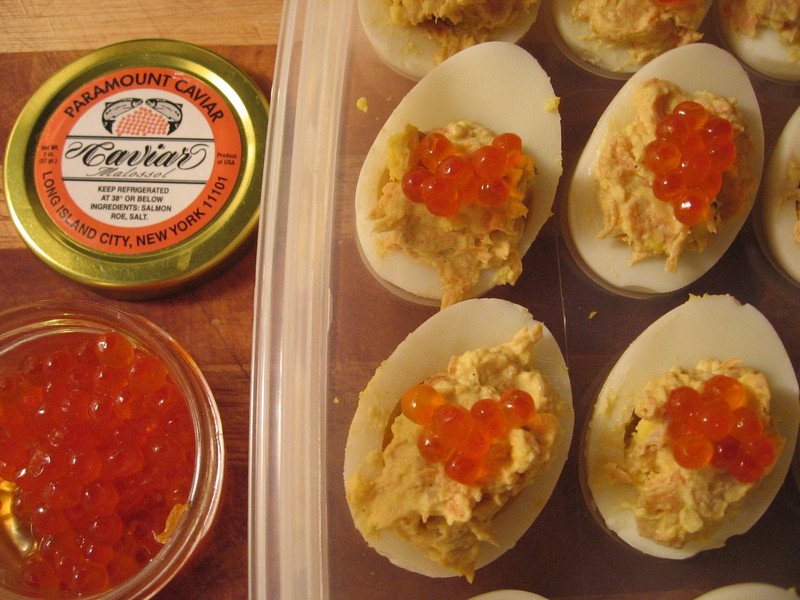
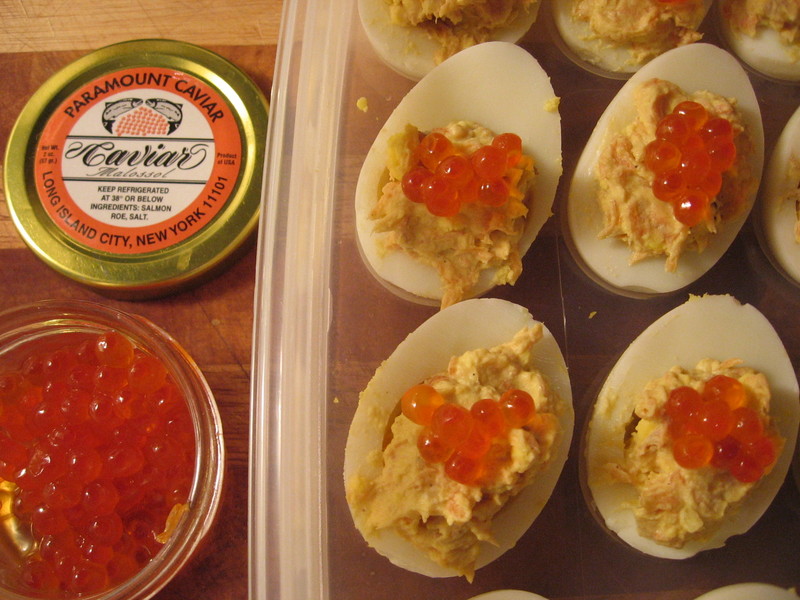
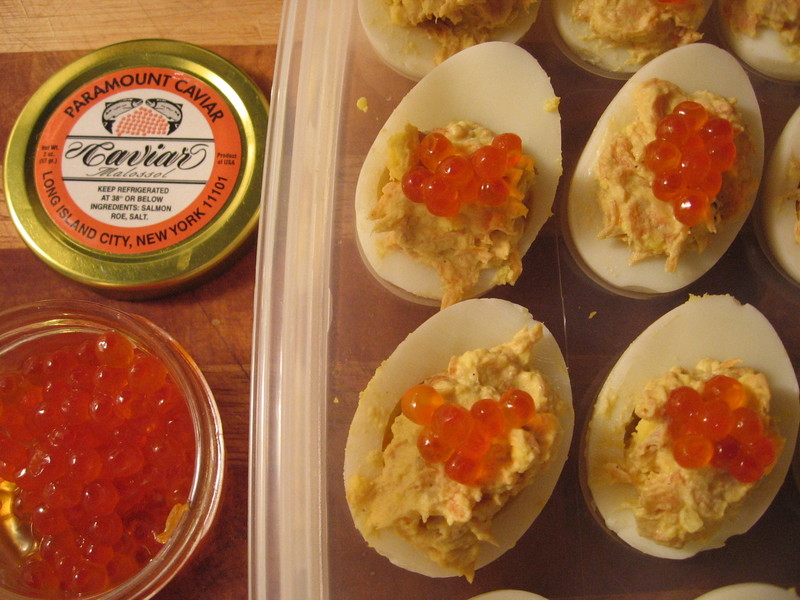
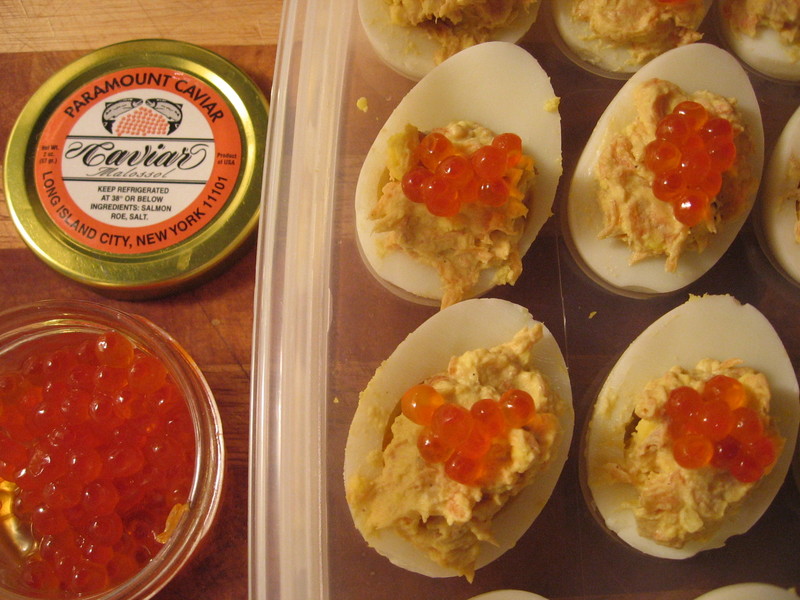
Eggs_5 On Christmas Eve I made Carmelized Salmon Deviled Eggs for a party. (Initially, I felt mild shame for using an Emeril recipe, but all was well when it turned out that another partier had brought a Rachael Ray creation.) Weird, I have no particular fixation on deviled dishes (which I thought meant mustard, but with the curry I think it means heat even though it does contain a touch of mustard). I just needed a recipe to make use of my impractical Rubbermaid egg carrier that I've only used once in three years.

Festival of Bites

Mithai make my teeth hurt and my tongue happy. I’ve always been a sucker for hyper pigmented foods, sweets in particular. But I’m more familiar with tiny S.E. Asian style snacks than these Indian counterparts. Where Malaysian/Singaporean kueh, Thai kanom and Vietnamese banh tend to be variations on glutinous rice, rice flour, coconut milk, agar-agar and mung beans (it’s amazing the mileage you can get out of small repertoire), mithai revolve around evaporated milk, ghee, chickpea flour, nuts and spices (often cardamom and saffron). Dairy definitely looms larger and creates a richness that coconut milk can’t.

I’ve come to know and love the fudgey-textured burfi (sometimes called barfi, but I prefer the more appetizing spelling) and syrup soaked galub jamun. The high sugar content isn’t what causes the tooth ache—my sweet tooth knows no bounds—it’s the sometimes used edible silver leaf that’s the culprit. I have the feeling that if these goodies were all whites and neutrals I would be less enamored of them than in their magenta and chartreuse glory. That is their beauty. Americans (of a certain type) tend to be down on the unnatural and artificial, but how do you argue with tradition? But then, I also like the fake green pistachio gelato better than the dull toned purist version.

There are quite a few places around the city to pick up some mithai. Sukhadia’s and Rajbhog are both chains, but there are also smaller shops and branches of these two biggies in neighborhoods like Jackson Heights and Richmond Hill, Queens (not to mention my new favorite New Jersey locale, Edison). Buying these gems is almost an old fashioned candy counter experience, they are tucked on trays in glass cases, come by the pound and are placed in a little box tied with string.

Having a limited knowledge of mithai, I only a vague idea what any particular item is since they’re not labeled or described in any fashion. And being NYC, there’s always a crowd around the counter so I feel pressured to move it along and pick and point quickly and without questions. But then, I’m overly sensitive to this sort of thing, holding up lines, looking dumb, when I see inquisitive, indecisive folks all the time.

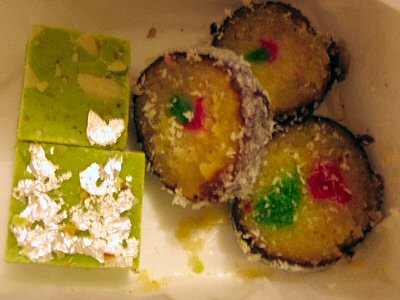
I recently stopped by a storefront whose name I can’t recall on 74th St. in Jackson Heights. My interest had been rekindled while reading a recent New York Times article on mithai, but I waited until the weekend after Diwali to beat the holiday hordes. I indulged in the sweets pictured below, and I’m not sure how long six pieces are meant to last, but I purchased them Saturday afternoon and had eaten them all by Sunday evening. That’s exactly why I can’t have candy sitting around the house.

Mithai

Pista (pistachio) burfi and something Rajbhog calls sweet cutlet, though I suspect that’s not its proper name.

Pepsi Re-Generation

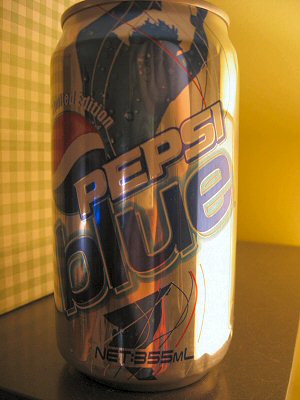
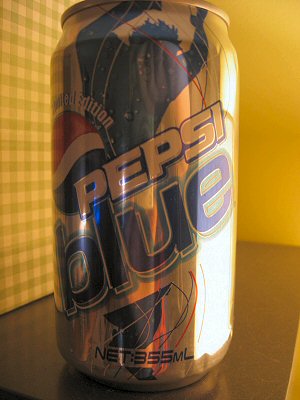
Bluepepsihk_2  I was wowed enough to find 7-Elevens in S.E. Asia (and boy, are the combo meals a doozy) but I almost lost it when I saw a display of limited edition Pepsi Blue in one of the Hong Kong stores. As I’ve boringly reiterated countless times, I don’t even drink soda (I like chewing sugar, but gulping it in liquid form seems pointless) but I love me some blue food. I’m kind of sad that the early ‘00s crazy color food fad has died down, at least in America. Maybe Hong Kong will pick up the slack.

Tom Yuck?

Ok, it might seem hypocritical to talk about something like tom yam pizza after just dissing Rachael Ray’s boo-sotto, but I never said I was classy. I’m harder on Americans than foreigners. I love the home cook, I hesitate to say house wife, geared sections of SE Asian publications like The Star. The food is almost all novel and atypical to me, so I don’t have issues if they’re oversimplifying or bastardizing recipes. 

That’s why I have no problems with Sylvia Tan’s books like Mad About Food. She doesn’t get too nuts, but does have a recipe for tom yam seafood pizza. So does Anya Von Bremzen in Terrific Pacific, the 1995 cookbook that totally got me started on my SE Asian kick. I’ve adapted the two into my own version.

Malaysians are crazy for anything tom yum, kind of how Americans equate pad Thai with Thai cuisine. By the way, Thai food sucks in Malaysia, it’s either bland and tame or Chinese food in disguise (same with Singapore and Hong Kong). I refused to believe this and couldn’t understand it since they share a border. Penang is less than one hundred miles from Thailand, like from NYC to Philadelphia (though some would argue that we can’t get cheesesteaks right). But Malaysians make anything tom yum: noodles, potato chips, buns, and yes, pizza (at Pizza Hut, no less). Who am I to buck a trend?

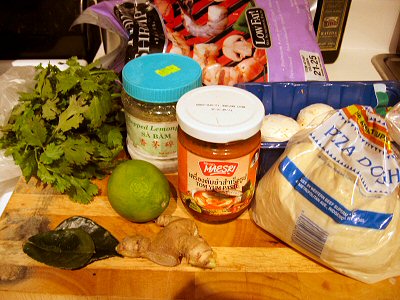
I was home alone tonight and trying to come up with Tomyumrawsomething that used up odds and ends cluttering up the fridge and freezer, and this was it. I used enough frozen products to make Clarence Birdseye proud: lemongrass, kaffir lime leaves, pizza dough and shrimp. The limes weren’t frozen, but ancient. Unfortunately, the half bell pepper and red onion I also intended to salvage had to be nixed since both were on the cusp of decomposing. I really cleaned house. I’d used up every last wisp of flour while making lamb pies on Sunday, so I had to improvise with cake flour, which was no biggie since it was simply for dusting

Cheese isn’t a must for this dish, but mozzarella is mild enough to not offend. But this evening I only had generic cheddar, American cheese, Chavrie goat, Pecorino Romano, light Laughing Cow cheese and a gruyere on hand (huh, that’s a lot more cheese than I realized, plus there was a moldy fontina butt end in the crisper), none of which seemed wise melted with seafood. But I went wild and grated the narrow remainder of gruyere since this was a pantry streamlining exercise.

Tom Yum Pizza

1 lime
1 teaspoon olive oil

½ tablespoon minced lemongrass

½ tablespoon minced ginger

8 ounces peeled, halved shrimp (squid works too)

2 tablespoons tom yum paste

1 squirt fish sauce

1 teaspoon sambal oelek

1 pound ball pizza dough

5 ounces sliced mushrooms, oyster preferred

Small handful coarsely chopped cilantro

2 kaffir lime leaves, shredded

Mozzarella cheese (optional)

Combine ginger, lemongrass, olive oil and juice from half the lime. Toss in shrimp and let marinade for up to one hour.

Tomyumbowls_1Mix tom yum paste, the rest of lime juice, fish sauce and sambal. Set aside.

Roll out dough and place on lightly oiled cookie sheet (preferably pizza pan).

Spread tom yum sauce over dough and top with shrimp, cut side down, and mushrooms. Sprinkle with cilantro and lime leaves. Mozzarella is optional at this point. Gross as it sounds, I’ve made it that way and it was tasty.

Bake at 500˚F for 10 to 12 minutes.

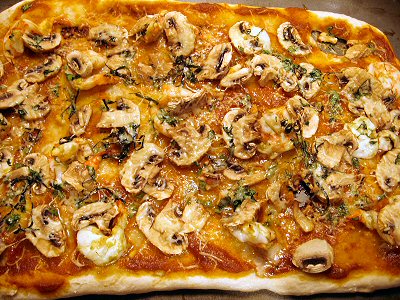
Tomyumpizza

It turned out satisfactorily, the cheese was just accent enough, but over all the pie was too salty. I’d use less tom yum paste and fish sauce next time, and probably increase the amount of shrimp. Those adjustments are reflected in the recipe above.

A Cashew Apple a Day

I like the idea of fruit discards, despite not being a big fan of fruit. I was really bowled over when I learned not that many years ago that cashews are really kind of a byproduct of an apple-like fruit. Why wouldn’t Americans eat the fruit? I thought perhaps it would be hard to transport, too perishable, etc., but I’m now suspecting it’s because the fruit tastes like crap. (Or not, apparently an Indian company is making Kazkar Feni, a cashew apple liqueur.)

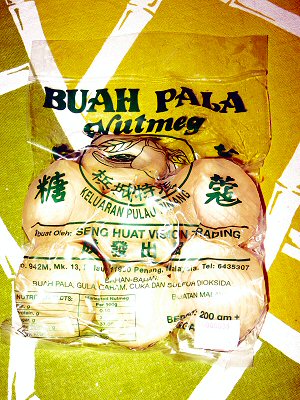
At least that’s the case with nutmeg fruit. I knew that nutmeg, the spice, is a grated giant seed, and that mace is the webby outer coating. But I’d never seen the fruit, which resembles apricot halves and was sold from liquid filled glass containers all over Penang. It took me a while to figure out these yellowish, floating, indented disks were nutmeg fruit. And while killing time at the airport, waiting for our flight to Kuala Lumpur, I noticed some vacuum sealed nutmegs in a bin with papaya and mango. The other two fruits are sweet and perfectly edible, so I figured nutmeg couldn’t be far off.

Nutmeg_1

I didn’t open them until I got back home, and decided to bring them (along with green bean cookies, which were an unexpected hit) to work as a surprise scary gift to share with coworkers. And scare, they did. They emitted a strong medicinal smell. I’m not sure if they were pickled, fermented or what, but they were beyond pungent. I don’t know if you’re supposed to eat them plain, but it was akin to eating a ginger root like an apple. A little goes a long way. I had to toss the whole bag. Despite its detractors, I’d take durian over nutmeg, any day.

Sarawakian Experiment

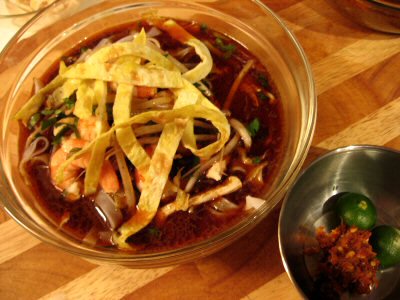
Laksapaste_4Sarawak Laksa

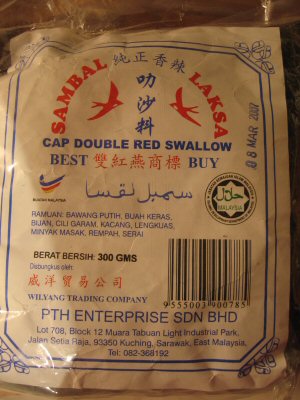
300g Sarawak laksa paste (I'm keeping this metric because that's how the paste comes packaged)

8 cups chicken stock

1 cup thick coconut milk

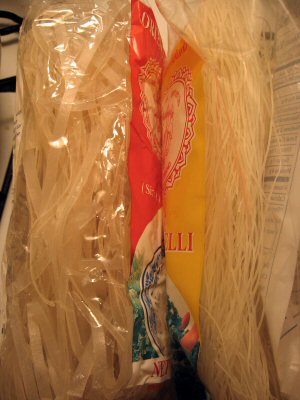
16 oz thick rice vermicelli (I couldn't’t figure out how thick they meant, so I opted for the thicker of the two types I had in the pantry. I'm pretty sure Sarawak laksa doesn't use the round rice noodles, which are next to impossible to find in NYC anyway)

Toppings

¼ cup beansprouts (you’re supposed to blanch, but I didn’t bother)

3 1/2 oz. chicken (half a medium breast) poached and shredded
5 large prawns cooked and shelled (I used half a pound of smaller prawns because I needed to use them up. Consider this an American adaptation, heavier on the protein)

Ricenoodles_2Garnish

2 eggs, cooked into an omelet and cut into strips
¼ cup cilantro leaves, chopped

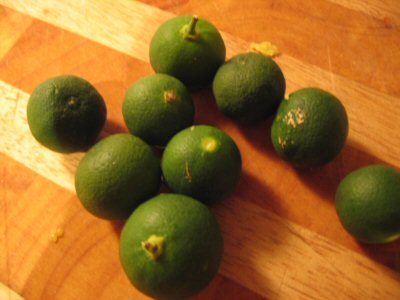
3 calimansi, halved (I lucked out in finding these at the Elmhurst Hong Kong Supermarket, as opposed to my usual Sunset Park location. Lime wedges would also be fine)

Boil laksa paste and chicken stock together for 15 minutes. Strain into a pot. Add coconut milk and mix well. Season to taste with sugar and salt.

Briefly boil dried noodles to soften. Drain, and divide into serving bowls. Add toppings in order listed. Ladle laksa gravy on top.

Garnish with omelet strips and cilantro.

Calimansi_4 Serve with sambal and lime halves.

Sambal
5 cloves garlic

2 shallots

Half a medium onion
¼ cup dried chiles, soaked in hot water
2 tablespoons dried shrimp, soaked and drained

5 tablespoons oil (the original calls for 6-8 tablespoons, but that felt excessive—hopefully, I didn’t ruin the flavor)
3 ½ tablespoons chile paste (I used sambal oelek)
1 tablespoon tamarind paste mixed with 3 tablespoons water

1 tablespoon sugar

½ teaspoon salt

Pound garlic, shallots, onion, dried chiles and dried shrimp into a paste using a mortar and pestle. Or alternatively, use a food processor. I usually go for the mortar and pestle (it's easier to clean, and of course more traditional) but I don't have the patience to break down the dried chiles properly.

Heat oil and fry the sambal ingredients until brown and aromatic. Add chile paste and tamarind liquid and season to taste with sugar and salt. Continue cooking over low heat for 25 minutes.

Serves four.

Adapted from Savouring Sarawak, Flavours, July-August 2005.

Sarawaklaksa_3 
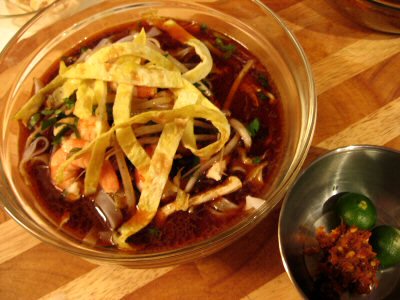
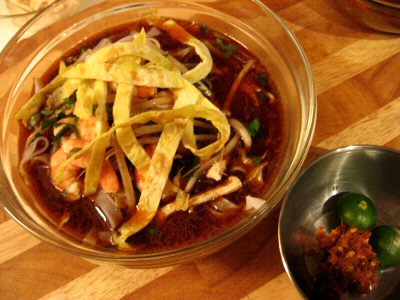
I'm definitely neither food stylist nor photographer, but you get the gist.

I was lucky enough to be given a package of Double Red Swallow Sarawak laksa paste as a gift when in Kuala Lumpur. This is the good stuff, straight from Kuching. It's hard to find even in Malaysia, never mind the U.S. I hope I did it proud. As I've never had Sarawak style laksa before, it's hard to gauge how close my version comes to the original.

I do think I my sambal turned out hotter than what I'd tasted in Malaysia. I have a high heat tolerance and it still burnt the taste out of my tongue (I just ate some with chicken and rice for lunch and my mouth is now numb). I was trying to measure the dried chiles with a food scale, using the metrics from the original recipe, but I don't think the calibration is sensitive enough–no matter how many chiles I piled on, the needle barely budged. My 1/4 cup suggestion  is less than what I used, and probably wiser.