Skip to content

Posts from the ‘International Intrigue’ Category

Beefing up the Selection

Western_beef_new_ads

It’s just a grocery store but I’ve always had a thing for Western Beef, at least the Ridgewood headquarters. It’s not remotely fancy, I can’t get my Kashi bars or Fage yogurt, just Quaker and Danon, but it’s certainly a notch above Associated or C-Town (Friday the NY Post had a funny full page ad where C-Town price compared a pile of around 25 Krasdale items to the name brands and showed how you’d save like $75).

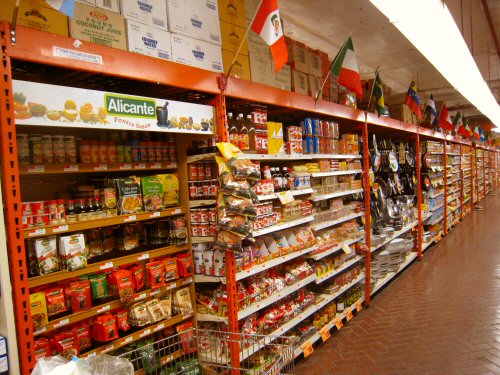
Western_beef_new_international_aisl

I was excited this past weekend to see that WB has revamped/reorganized its “ethnic” offerings, which consists of a bounty of Latin American and Caribbean brands with a few Eastern European items tossed in. You’re shit out of luck if need anything Asian besides Kikkoman or Roland duck sauce (in humungous jars). I don’t know that they increased their offerings but they’ve tidied up the shelves, erected mini flags from countries of origin and put signs out front advertising their diverse products. I thought they might’ve actually alphabetized since Argentina was first, but then Peru snuck in near the start of the aisle and all rhyme or reason went out the window.

Western_beef_many_maltas

They also tidied up an entire row devoted the only other foodstuff in existence (besides melon) that I can't abide. Malta is an acquired taste that I just can't acquire. 

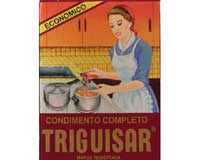
TriguisarI couldn’t resist this little Colombian box of Triguisar. I'm sure it is seasoning, though the translation reads "economic dehydrated mixed condiments" that consist of cumin, pepper, garlic, annatto, something they translate as curcuma (ah, turmeric), yellow dye, corn starch and corn rice. I’m not convinced of its tastiness but like the straightforward directions, “it should be cooked with the foods.”

Not only was the Western Beef so bizarrely empty that I could wheel the cart around unimpeded, the same non-crowdedness occurred at Target the same Saturday afternoon. We got a parking spot next to the door instead of having to drive in circles and there were actually shopping carts instead of the usual empty patch of dirty carpet where they’re supposed to be. It kind of freaked me out. Plus, instead of the normal reggaeton blasting at WB interspersed with an angry employee yelling for his keys, soft jazz was lilting from the speakers. New management or something more malevolent?

More: western beef

Sunday Night Special: Pork in Caramel Sauce & Pickled Bean Sprouts

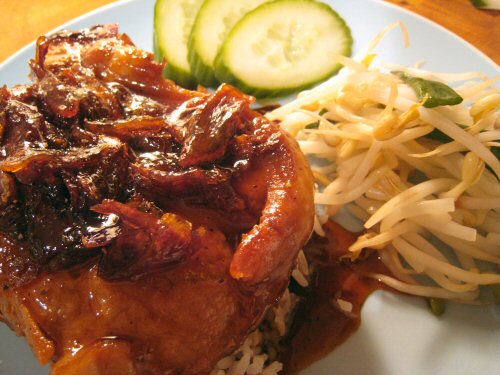
Pork_chop_with_caramel_sauce

While trolling the internet I used to save recipes I might seriously make in a word document ingeniously called recipes. I haven’t touched or updated it in years. But I was reminded of its existence on my hard drive after eating a pork tenderloin in caramel sauce at Silent H a few weekends ago.

The first recipe I ever added to my list was Mark Bittman’s take on this dish, beef tenderloin in carmelized sugar, from an October 30, 2002 New York Times. It was really easy and unbelievably good (quick enough for a Monday night—I’m fudging the category because I didn’t cook on Easter). I made it once. In an effort to strive for authenticity, I looked in a few Vietnamese cookbooks and online sources but I decided to stick with his version.

It appears that this recipe also can be found in his The Best Recipes of the World (click on Southeast Asia on the left menu), a book I had completely forgotten existed until literally about two hours ago when I decided to watch a taped version of Bittman’s new TV show that aired this weekend. I didn’t realize the show was a tie-in with this book. It was a fitting coincidence that I decided to crack out the ol’ carmelized meat recipe when I did.

I substituted semi-thick pork chops for the beef called for and just cooked the meat a little longer. I’ve never exactly pinned down umami but I imagine that this dish is teeming with it. The sauce would almost be too salty if it weren’t for the hefty dose of melted sugar, which turns everything gooey like a piquant fishy candy. That’s a good thing.

Beef Tenderloin in Caramelized Sugar

4 pieces filet mignon, each 1 inch thick
1 cup sugar
1/2 cup nam pla, or to taste
1 large onion, cut in half-moon slices
1 teaspoon black pepper, or more.

Put a 10-inch skillet over high heat. Wait a minute. Add meat, and brown on both sides. Turn off heat, and place steaks on plate.

A minute later, add sugar to pan, and turn heat to medium. Cook, gently shaking pan, until sugar liquefies and begins to bubble. Cook another minute until it darkens, then turn off heat. Mix nam pla with  1/2 cup water. Carefully add liquid, and turn heat to medium-high. Cook, stirring constantly, until caramel melts into liquid. Add onions, and cook, stirring, about 5 minutes. Stir in any liquid that has accumulated around meat.

Stir in black pepper, and return meat to pan. Cook over medium heat, turning meat once in a while, until it is done to your liking (about 5 to 8 minutes for medium-rare). Taste, and adjust seasoning, then serve, spooning onions and sauce over each steak.

Serves 4

As a side, I made an even simpler accompaniment of pickled bean sprouts from Nicole Routhier’s The Foods of Vietnam. I halved this recipe because as tasty as they are, you can only eat so many bean sprouts and they don’t keep well.

Pickled Bean Sprouts
Dưa Giá

1 pound fresh bean sprouts
1 bunch of scallions, cut into 2-inch long sections
1 tablespoon salt
½ cup white vinegar

Mix the bean sprouts and scallions in a large bowl.

Combine the salt, vinegar and 4 cups of water in a small saucepan. Bring to a boil. Cool until warm to the touch. Pour the brine over the bean sprout mixture. Marinate for at least 1 hour, or until ready to serve. Drain before serving.

Serves 4 to 6

Getting Your Jollies

Joelstein Joel Stein is like a less wry Mo Rocca (I can’t help but mention at any mildly opportune moment that he sat directly in front of me en route to Chicago in February) laced with a touch of good ol’ fashioned Dave Berry. In a word, douchie. And apparently Time magazine has deemed him fit to write a food column. I hate voices of my supposed generation on any topic…but food? Really? It’s much better when they stick to two-liners on I Love the ‘80s.

Foreign fast food chains are a topic near and dear to my heart so I couldn’t help but peek at his first foray into culinary commentary, "The Hungry American." Uh, and maybe I’m misinterpreting his interpretation, but he seems to be of the mind that chains set up in America to try to appeal to us and get it all wrong. That might be the case if he were talking about Pret a Manger overdosing the U.S. with mayonnaise. Yet the examples he cites are California-centric, for one, but inaccurate since they are primarily restaurants catering to expatriates.

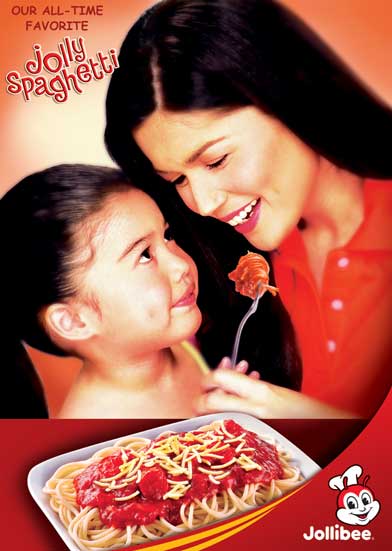
Jollyspag Minus the Jollibee burgers, this isn’t really “foreign American food.” I don’t think this Filipino chain is trying to entice the general public with gusto, and if they are then spaghetti topped with ketchup and sliced wieners is a charming yet off kilter business plan. I don’t know that the businesses in his commentary are trying to resell our culture back to us as much as that they’ve interpreted fast food for local audiences and are reaching out to immigrants who’ve settled in the U.S.

I don’t think Guatemalan Pollo Campero, at least in NYC, had made an effort to attract non-Central American customers. In fact, the one in Sunset Park went out of business for that very reason, the neighborhood was more Mexican and Puerto Rican and didn’t identify with the brand. Practically all cultures like fried chicken, we don’t own the concept.

And for Stein to posit that Beard Papa is interpreting donuts for Americans is insane. They’re not mimicking our fried dough, they’re making cream puffs. Japanese (and Asians in general) love French shit. I had great pastry in Hong Kong and Singapore.

And his conclusion is frighteningly self-revealing: “To them, it seems, we're a happy, efficient, fun bunch of guys, even if we act like total jerks when it suits us. They've figured it out: we're frat boys. And we like to eat like them.” Yikes. I wonder how those crazy Filipinos might re-create the beer bong, don’t you? And Nicaraguan jello shots? Just a matter of time.

Sunday Night Special: Menudo

Neither of my parents could’ve qualified as good cooks during the many years I lived with them. We probably ate breakfast for dinner twice a week and fried eggs, bacon, grated cheddar cheese and salsa wrapped in flour tortillas are the only thing I even recall my dad churning out. Breakfast burritos were about as Mexican as it got in my household, too. 

Well, Tex-Mex enchiladas, along with lasagna–another baked dish adept at feeding crowds–were my mom’s two company’s-coming-over standards. The one anomaly, which I’ll have to ask her about, was her taco technique. She would deep-fry corn tortillas when making tacos while all of my friends’ families used those crunchy shells from a box. I’ve since learned that the puffy oil-dipped style is Texan, a state no one on my maternal side has any ties to. I have no idea where she picked that up because she’s way more of an out of the box woman than an extra step type.

I’ve never been given a straight answer as to when either sides of my family came to America and where they even came from. The closest I could gather from my father was that his ancestors lived in Texas before it was a state. That’s kind of weird, like my relatives didn’t come from anywhere; they were just hanging out in America already. But I don’t see how that century-old-plus connection could’ve had any influence on my mom frying corn tortillas.
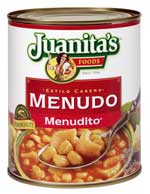
Menudo_menuditoEpisodes that only occurred a couple times in childhood often multiply in the mind years later. My dad likely bought a big can of Juanita’s menudo two or three times, though I remember it as a more regular purchase. I thought the crimson, lightly spiced soup crammed with monster-sized white pieces of corn was the coolest thing ever. It was much more exotic than Campbell’s bean with bacon, my favorite up until that point.

My father and I were the only ones who’d eat it. Tripe was alien and like nothing I’d encountered before. The fact that it was cow stomach didn’t bother me–I was never grossed out by things like giblets either and had no problem eating pet food on dares. My sister turned out the opposite and grew up into a vegan whom I think has loosened up and started eating cheese. Cheese is one animal product worth clinging to.

I liked anything different or underdoggy. When given a choice between blue and white Trax (Kmart’s house brand) or tan and sienna, I chose the dirt colored combo because they were uglier and not the Nikes I wanted in the first place. Eventually I grew to genuinely enjoy the contrary. Maybe a lot more kids had to wear Trax than I realized at the time since like it not, irony is such a trait of my generation. ‘80s kids are way more straightforward and jubilant (and could use a good spirit-crushing).
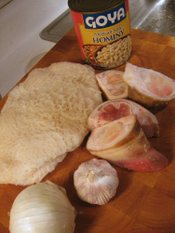
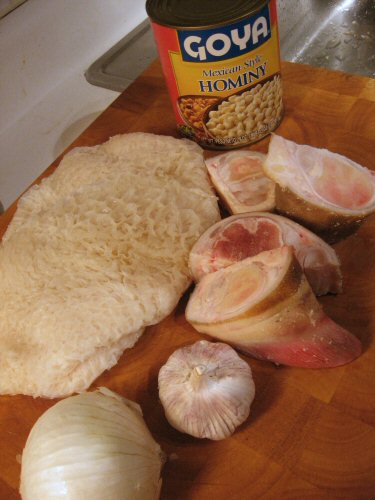
Menudo_ingredientsYou don’t see menudo in cans much here, or even freshly prepared on menus. It’s standard weekend fare on much of the west coast but NYC doesn’t necessarily follow the rules. Yesterday, I visited a tiny lunch counter in the Bronx, Real Azteca, and they had pancita, a tripe soup which I suspect is similar to menudo if not the same thing. I was just in the mood for tacos, though.

It had never occurred to me to try and cook my own menudo but it seemed like the perfect Sunday afternoon project. I know menudo is morning food but I rarely get out of bed before noon (and I didn’t even go out drinking on St. Patrick’s Day).

Finding a good recipe proved more difficult than I’d expected. For one, I don’t own a single Mexican cookbook, which is plain sad. In fact the only Latin American cookbooks I possess are a ‘60s Time Life Foods of the World volume and Havana Salsa and Daisy Cooks, which were freebies because I reviewed them for the New York Post. Not counting multi-cuisine (primarily S.E.) Asian cookbooks like Hot Sour Salty Sweet, New Wave Asian, The Occidental Tourist and the like (19 in all), I have 12 Malaysian, 7 Thai, 4 Singaporean, 2 Vietnamese and even 2 Filipino and I never ever cook Pinoy fare. This Mexican cookbook situation must be rectified pronto.
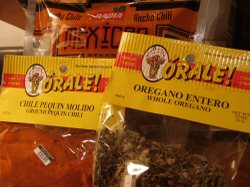
Menudo_extrasI turned to the internet but every recipe seemed slightly off to me. The Diana Kennedy one floating around had no call for liquid which had to be a misprint and contained no seasonings whatsoever, possibly because it was for white menudo. I didn’t want white. Others were too fancy and called for bay leaves and employed bouquet garni. Some put chopped green chiles in the broth and I don’t think anything but red and dried chiles belong. I’m so not a recipe writer, so I borrowed bits from all over as part of the learning process and would change a few things next time. I’m not saying what follows reflects any authenticity but it felt right.

Menudo (attempt #1)

2 pounds honeycomb tripe
1 calf’s foot, chopped into chunks
1 white onion, roughly sliced
1 clove garlic, sliced in half horizontally
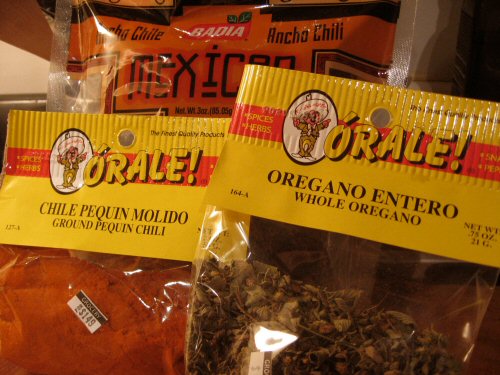
1 ancho chile, toasted and ground
1 sprig thyme
1 teaspoon peppercorns
1 28-ounce can hominy
1 teaspoon Mexican oregano
water
salt

For garnish
chopped cilantro
chopped white onion
piquin chile powder
lime wedges

Place calf’s foot, garlic and onion in a large pot and sprinkle with salt. Top with tripe and salt a little more, then pour water to cover all the ingredients. Add peppercorns, thyme and ancho chile powder. Bring to a boil, then turn down heat and simmer for about two hours.

Strain out the ingredients. The garlic and onion can be tossed, any meat from the calf’s foot can be shredded and the tripe should be cut into one-inch pieces. Return the meat to the liquid. Add the hominy and oregano. Simmer for another two hours.

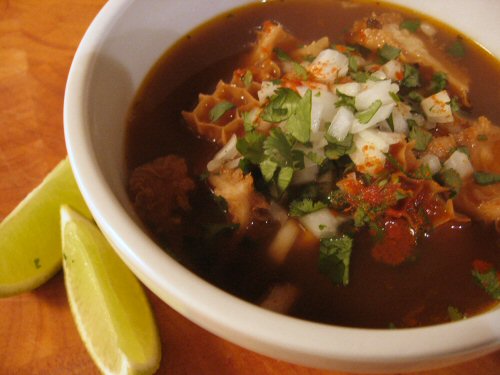
Skim off any foam or oil that has accumulated on the surface. Add salt to taste and serve garnished with chopped onion, cilantro and chile powder and lime wedges.

Serves 6-8

Adapted from here, here and here.
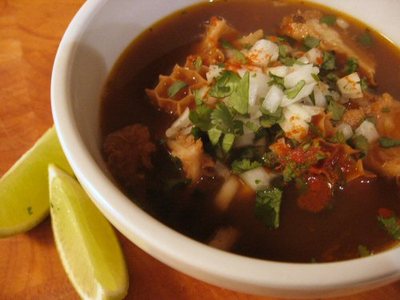
Menudo

I’m still not 100% sure about the process. Next time I would cut the tripe before cooking it. There wasn’t any meat on my cow’s feet so there wasn’t anything to remove and add the pot. And I was confused by the onions and garlic. I’m assuming they had to be strained out because menudo doesn’t have chunks of aromatic vegetables floating in it.

Even after adding ancho chiles, thyme and oregano, which weren’t a part of the original recipe I was following, the broth tasted a little flat. It smelled and looked richer than it was. And my tripe was too tough (I didn’t cook it as long as I’ve indicated above). But after re-heating the pot full the next day the flavors had melded and the meat had softened up. This is a work in progress and I plan on revisiting tripe soup after I do a little more research.

Sunday Night Special: General Tso’s Chicken

Ok, this isn’t technically a Sunday Night Special, but I didn’t cook on the day of rest because I had a huge late lunch at Pio Pio. Tonight I made what I would’ve wanted to cook on Sunday night if I'd been hungrier.

I’m sure I’m not the first to discover what a deal Amazon’s free super saver shipping is. You’re entitled if you spend over $25 and they warn that it will take 5-9 days just to scare you off but it never takes that long. Just Sunday I ordered Fuchsia Dunlop’s brand new Revolutionary Chinese Cookbook: Recipes from Hunan Province (as well as Memories of Philippine Kitchens and Nueva York: The Complete Guide to Latino Life in the Five Boroughs [I'm trying to learn more about the Bronx]). I was inspired after killing time in the airport the day before, reading her recent General Tso’s chicken article off a handheld device from a copyright violating website. I couldn't believe that an Amazon box was sitting in the hall when I left for work this morning. Very impressive.

I must not get out much because I’d never heard of this popular chicken dish referred to anything other than Tso’s or possibly Tsao’s, and I grew up in a city completely lacking in authentic Chinese food. This Gau’s and George’s business is nuts (but then, I’ve also heard that you can get white bread with Chinese take out in Boston)

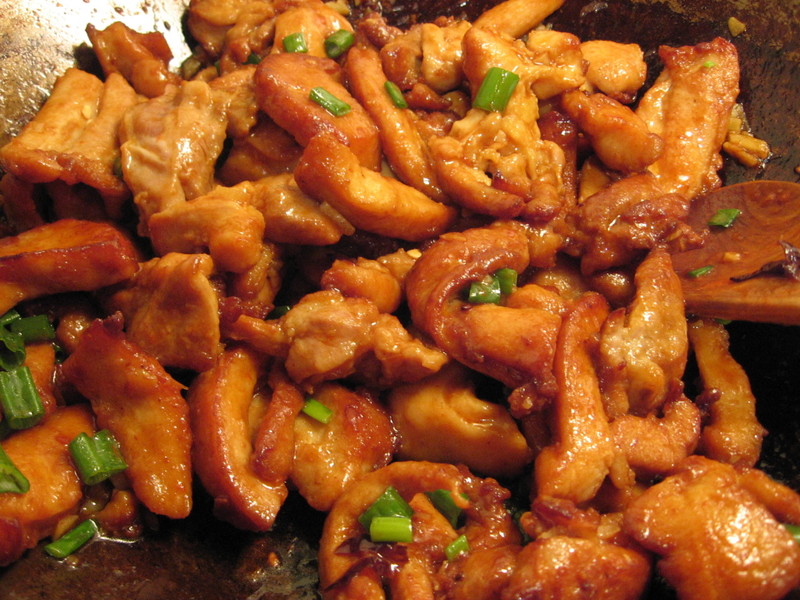
General_tsos_chickenI’m all about the dark meat, despite always having a stash of listless Costco chicken breasts in the freezer. Thighs are so much tastier, so I followed this suggestion in the recipe. Unfortunately, we didn’t scrutinize the cooking instructions before shopping on Sunday afternoon and only picked up a pack of three thighs. To make up the difference, I tossed in a sliced chicken breast. There was no contest between the two cuts. Funny that General Tso has recently prompted a light vs. dark discussion elsewhere.

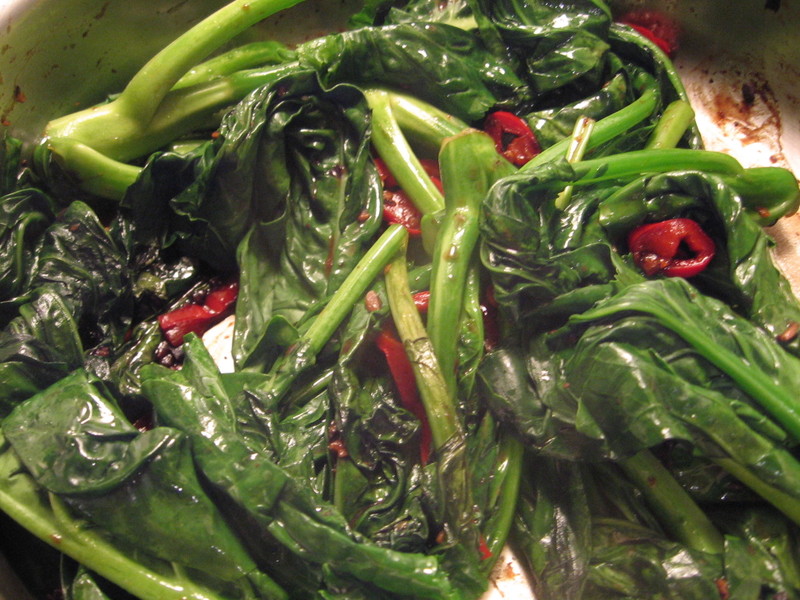
The only thing we had to pick up was potato flour and some gai lan as a side (I realize American broccoli would’ve been truer to take out form). Loosely based on a water spinach recipe in the Revolutionary Chinese Cookbook, I stir-fried garlic, black beans and sliced red chile, then added the broccoli and covered for a few minutes to steam. I finished the dish with a splash of rice vinegar and a drizzle of sesame oil.

Gai_lanThis Hunan by way of Taiwan recipe isn’t sweet as typical General Tso’s is, and that’s fine by me. (I just noticed that the recipe floating around on the internet is a copy of what was in The Times and has been edited differently than what's in the book. ) There is a Changsha version on the following page of the cookbook that looks nearly the same yet uses white sugar, more ginger and no garlic. I stuck with the more savory approach even though I will admit to enjoying the crispy, candied, hyper-battered, American-Chinese meat chunks. Lightly sauced, velvety slices of moderately spiced chicken aren’t so bad either.

General Tso’s Chicken (Taiwan Version)
Zuo Zong Tang Ji

4 boned chicken thighs with skin (about 12 oz. total)
6-10 dried red chiles
2 tsp. finely chopped fresh ginger
2 tsp. sesame oil
Peanut oil for deep-frying
For the marinade:
2 tsp. light soy sauce
½ tsp. dark soy sauce
1 egg yolk
2 tbsp. potato flour
2 tsp. peanut oil

For the sauce:
1 tbsp. double-concentrate tomato paste mixed with 1 tbsp. water
½ tsp. potato flour
½ tsp. dark soy sauce
1 ½ tsp. light soy sauce
1 tbsp. clear rice vinegar
3 tbsp. stock or water

Thinly sliced scallion greens to garnish

1. Make the sauce by combining all the ingredients in a small bowl. Set aside.

2. To prepare the chicken, unfold the chicken thighs and lay them on a cutting board. Remove as much of the sinew as possible. (If some parts are very thick, cut them in half horizontally.) Slice a few shallow crosshatches into the meat. Cut each thigh into roughly 1/4 -inch slices and place in a large bowl. Add the soy sauces and egg yolk and mix well. Stir in the potato flour and 2 teaspoons peanut oil and set aside. Using scissors, snip the chilies into 3/4 -inch pieces, discarding the seeds. Set aside.

3. Pour 3 1/2 cups peanut oil into a large wok, or enough oil to rise 1 1/2 inches from the bottom. Set over high heat until the oil reaches 350 to 400 degrees. Add half the chicken and fry until crisp and deep gold, 3 to 4 minutes. Using a slotted spoon, transfer the chicken to a plate. Repeat with the second batch. Pour the oil into a heatproof container and wipe the wok clean.

4. Place the wok over high heat. Add 2 tablespoons peanut oil. When hot, add the chilies and stir-fry for a few seconds, until they just start to change color. Add the ginger and garlic and stir-fry for a few seconds longer, until fragrant. Add the sauce, stirring as it thickens. Return the chicken to the wok and stir vigorously to coat. Remove from the heat, stir in the sesame oil and top with scallions.

Serves 2 to 3

Adapted from “The Revolutionary Chinese Cookbook” by Fuchsia Dunlop. W.W. Norton & Company, 2007.

Food Felons

Petit_fours I can totally sympathize with this “Sweet Tooth Bandit” who spent nearly $700 at Swiss Colony using a stolen identity. I used to become desperate and tormented every holiday season when the unsolicited Swiss Colony catalog showed up on the mail. I would longingly page through the wish book, coveting the petit fours with all of my grade school being. I never ever got a single item from Swiss Colony and now that I have free will (and better taste in confectionary) I feel less compelled to order anything. If there’d only been an internet in the early ‘80s, who knows what havoc I might’ve tried to wreak.

–It’s not every day that fried chicken brings out the firebug in people. I do love the NYC brand name bastardization process. Somehow Kentucky Fried Chicken (don’t forget the Kitchen Fresh Chicken fiasco) becomes Kennedy Fried Chicken and then JFK Fried Chicken emerges.

I discovered the regionally confused chicken Maryland when I was in Penang. I never ordered any, but it appears to be fried chicken served with fried bananas, fritters, fries and sometimes sausage or bacon. Does that scream Baltimore to you?

The unanswered question in this arson case is why a Twin Donut would be selling fried chicken at all. Franchises are so renegade in NYC–I recall there used to be a Blimpie that sold Thai food on the side and a Chinatown Popeye’s that hawked pork dumplings under the counter. I’m sure there are countless other examples.

–Ok, malnourishment isn’t a felony but if your eating disorder fucks up my commute something criminal just might happen.

$70 of Joy

Cover_sepoct2005 When is a magazine worth $70? It doesn’t fight “stubborn belly fat,” so how to justify the expense? The cover price works out to a mere $2.30 or so but the $54 shipping from Malaysia kills me. I love Flavours more than almost any food magazine I’ve found, despite the fact that I’ve never cooked single thing from it. My subscription just ran out and I’m going to have to bite the bullet.
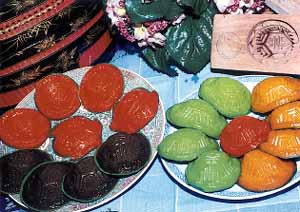
The writing is ok, the thing is rife with advertising/pr blurring usually reserved for small town dailies, they only recently started noting which restaurant reviews were anonymous (and vice versa), but the magazine taps into a twisty culture that I’m fascinated by. When people think Malaysia, they think quintessential street food and they’d be right. In fact, there was just a travel piece in the New York Times on the topic. I had some of the best dishes ever on my visit last year. The region’s residents are food crazy, and rightly so. Eating and obsessing on where to eat is a perfectly acceptable hobby. Makansutra had this niche pre-blog era. It’s no coincidence that many of the original food bloggers were based out of Singapore and Malaysia (I recall reading a few years back when Friendster was the big thing that after the U.S., Malaysia had the highest number of members) and they continue in their proliferation. Singaporean Chubby Hubby seems to currently have the corner on the slick, anything but amateur market.

But there’s not a lot of high-low mingling, it’s either hawker or haute. Western food frequently fills the gap in the middle. Malaysians might take offense at this, but as with many nationalities, their tastes tend to be provincial. They like what they know and are incredibly particular about minutiae like subtle differences in broth at various stalls. Yet they’re not so critical with foreign flavors. I was initially baffled how Thai food could be better in NYC than 100 miles from the Thai border. Most of what I saw tended to revolve around noodles or was something not terribly Thai dubbed tom yum (though I have to admit that tom yum pizza sounds like an awesome invention) in the way we’d stick pineapple on something and call it Hawaiian.

Flavours definitely dallies in the higher end but it is tradition-bound too. The tone is aspirational, occasionally fawning and sometimes misguided. I love the hodgepodge. Picking the January/February 2006 issue off the shelf randomly, the first ad for Maggi celebrates Chinese New Year with the tagline, “customs may change but good taste is forever,” which sums everything up. Honestly, I don’t even know what the original customs are—maybe that’s why I can enjoy how they jumble them all up.

F_koo1 Content from this issue includes "The New Oriental Splendour" and pictures pretty amuse bouches of prunes & bacon with pan-fried potato and cherry tomato with Chinese bbq meat; "New Year with the Nonyas," which features old school dishes like hati babi bungkus (pork liver balls);  "Old-fashioned Favourites," profiling nostalgic snacks from yesteryear like fah sang koh and ham chit soo that are completely bewildering to me; a column from a French chef who teaches at the French Culinary School in Asia on how to cook lamb, the premise being that “Malaysians do not know what to do with lamb.” The roasted lamb rack with tapenade & black olive mashed potato looks pretty good.
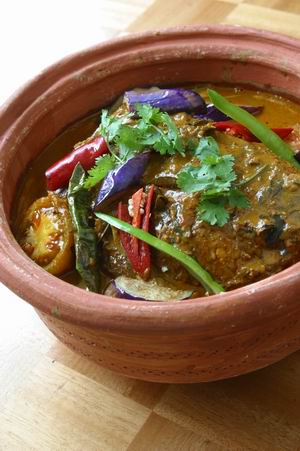
Then there’s an insane feature on truffles (Perigord black truffles were quoted at RM3,000 to RM4,000 per kg. Hmm, that’s $400-500 a pound, probably about right) with a recipe for truffle puffs, essentially typical curry puffs stuffed with foie gras and truffles. It’s probably tasty, despite its ostentatious premise. Not so palatable is a cocktail they’ve devised called an azur, which is a glass of Chardonnay drizzled with blue Curaçao.

They review a place called Fondue House and are sure to point out that recipes have been tweaked for local palates, many have low alcohol content or none at all, and the bacon cheese fondue uses beef bacon. Sometimes you forget when reading flashier publications that the country is predominantly Muslim. I recall being surprised that our room service breakfast at a perfectly modern hotel had a choice of beef bacon, turkey ham or chicken sausage. No pork to be found.

I’m enamored with how the mixed culture—Malay, Chinese, Indian, British, Portuguese—all put a mark on local cuisine and how this natural fusion informs how dining is interpreted. It’s a weird scene. Last year, in Kuala Lumpur, we went to Frangipani, a swanky creative restaurant, and were two of only eight diners in the vast space, all Caucasian.

Tk_fishcurry_1  The concept hasn’t been fully embraced yet, and for good reason—it’s really freaking expensive. Our bill was around $150, more on par with a New York restaurant. Meanwhile, a bowl of laska at sit-down Madame Kwan’s goes for around $3.50, and locals complain (you can get it on the street for under one dollar). It’s like these Chinese monster malls filled with luxury goods but necessarily enough clientele. The transition is too fast and unattainable for the mainstream. (Coincidentally, there was just a related discussion on egullet about the lack of high end dining threads.)

I know it’s strange that I don’t enjoy this type of coverage when it’s home grown. Maybe that’s because New York is oversaturated with gloss. Or maybe it’s because Flavours’s style is highly un-American. When they mix Western flourishes in, which they often do, it’s European or Australian. Nods to the U.S. are nearly non-existent (they murder Mexican food—cajun spices, gouda and baked potato with your burrito?) Sometimes it’s fun being an outsider, totally unjaded and learning everything from scratch.

Sunday Night Special: Thai Beef Salad

I think it's generally accepted that salads are good hot weather food. It's too bad that salads tend to be really boring, or maybe I just hate the varieties that I make myself. I'd much rather eat a professionally crafted bowl of greens than suffer through my sad renditions.

Thai salads are easy to make, generally healthy and taste a hundred times better than some god-awful Caesar concoction. I went for beef because we had a Styrofoam flat of economy type steaks in the freezer. They weren't really suited for purist treatment, but became a perfect meaty sponge for herbs and spice.

There doesn't seem to be a hard and fast recipe for this dish (nor a proper name–I thought it was yam nuea, but the recipe I settled on was called nahm dtok, which must be off because Googling that phrase only brings up 25 hits. I suspect the dish is more Laotian, which may or may not have anything to do with its small web presence). Some are more like a larb and use roassted rice powder and chile powder rather fresh chiles. Tomatoes, scallions, or mint sometimes show up and sometimes don't. I went a little insane trying to find a definitive version.

Eventually, I just gave up and looked to David Thompson's Thai Food. It was one of the simplest recipes I found and the man knows his shit. My only beef is that he doesn't specify servings (perhaps this is explained somewhere in the book and I missed it). I would guess that using 5 ounces of meat would make this for one. I mean, Americans eat 12-ounce slabs at steakhouses. I suppose if you were being more Asian and serving lots of dishes with small portions intended 5 ounces would suit more eaters. But then, I treated this as a main entrée and doubled it for two.

Grilled Beef Salad
Nahm Dtok

5 oz. beef rump or sirloin
4 red shallots, sliced
2 tablespoons shredded pak chii farang
handful of mixed mint and cilantro leaves
1 tablespoon ground roasted rice

dressing
pinch of white sugar
3 tablespoons lime juice
3 tablespoons fish sauce
very large pinch of roasted chile powder

First, make the dressing; it should be pungently hot, sour and salty.

Chargrill the beef to your taste. Slice beef, and combine with shallots and herbs. Dress the salad and sprinkle with roasted rice.

Serve with a wedge of cabbage and a few snake beans.

* * *

I didn't use the pak chii, which I just learned is culantro (a.k.a. sawtooth herb), not a super hard herb to find in many parts of NYC since it's popular in Puerto Rican cooking. I used to think grocers were just misspelling cilantro because they seem to enjoy doing that quite a bit, but that is the commonly used name here. And I used a mixture of shallots and red onion and tossed in half a tomato, just to use up produce that had been languishing in the fridge.

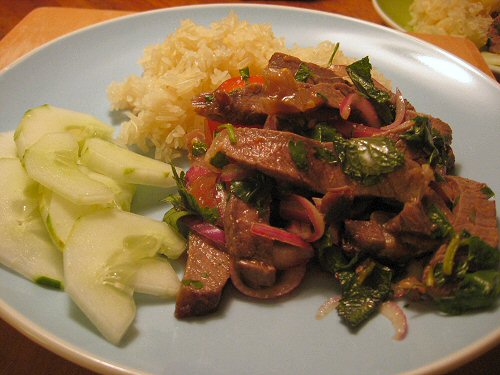
Nahm_dtok Northern Thai salads call for sticky rice. I happened to have the glutinous grain, but didn't have the proper set up. I really just need to buy one of those Thai rice steamers because improvising with a metal vegetable steamer in a large pot is a mess. You need cheesecloth and I just put the soaked rice in loose and it got too wet. The end result was more mushy than sticky, though it firmed up a bit after getting some air.

I opted for cucumber slices on the side. As you can tell from the photo I'm not presentation obsessed. The cucumbers had strips of missed skin still on and seeds that didn't fully get scooped out. I had also intended the meat to be rare, though it came out more medium-well. Gordon Ramsey would call me a donkey or a fat ass or something if he got a load of my kitchen standards.

Bonus Yam/Yum/Thot Fun

  • And because I have a more than minor obsession with name brand bastardized recipes, here's a Kraft doozy that calls for peanut butter (unbranded), A.1. Teriyaki Steak Sauce and KRAFT LIGHT DONE RIGHT! Zesty Italian Reduced Fat Dressing. At least they have the decency not to use the word yum in the title.
  • Hormel's rendition is a little less disturbing, but does make bizarre use of HERB-OX® Beef Flavored Bouillon Granules.
  • Here's a most awesome adaptation from Hidden Valley that uses, yes you guessed it, Hidden Valley® The Original Ranch® Salad Dressing & Seasoning Mix. Or as us common folk call it, ranch dressing.

Sunday Night Special: Penang Fried Chicken

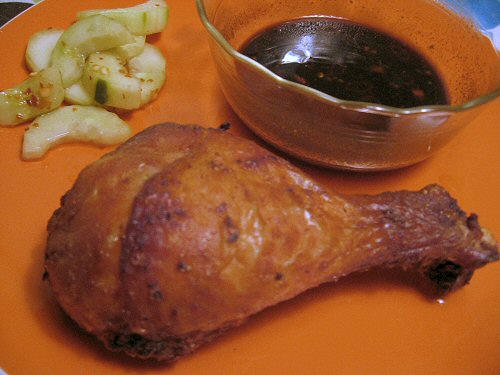
Penangchicken I woke up this morning wanting fried chicken. Hey, it happens. On those occasions when you practically drink until dawn, delicate light fare just doesn't appeal. Grease and spice, while probably not the wisest choice, is where it’s at.

I've never made or even tried Nonya style fried chicken, but I've always been intrigued by the notion. We defrosted a slew of drumsticks and I decided to make five my way. James is a purist and didn't want anything to do with my poultry aberration. Each to his own.

I'm looked at about five recipes before deciding on this one written by an American rather than a Malaysian. It seems that traditionally, the chicken is marinated, dried and then fried twice, that's it. But I like a little coating on my fried chicken, so went with a version that employs a light dredging.

Some make the curry powder from scratch. Some simply call for meat curry powder, a designation possibly unique to Malaysian recipes that always confounded me. They frequently specify fish curry powder or meat curry powder. Curry powder in America is kind of general as it is, though I have a bottle of Vietnamese and a can of Indian. It never occurred to me that different meats would require different spice blends, though it certainly makes sense. I made sure to pick up packets of each type, Baba's brand, while in Kuala Lumpur last summer. It looks like the main difference is the prominence of turmeric in the fish curry powder.

Though not always specified, when Singaporean-Malaysian dishes call for mustard powder I think they mean hot English style, like Colman's. Colonial influence, correct? Look no further than the Worcestershire sauce for that tip off. But I haven't found it in the few places I've looked, not even the new amazingly stocked Fairway. (But I could've missed it since they have this annoying display style of not putting like with like. Instead they separate pedestrian from gourmet. The standard cheddar and Monterrey jack blocks are in the back of the store, while all the artisanal cheeses are near the front cheese counter. Salsa shows up in three places: store-made with deli items, brands like Frontera in one spot and Old El Paso types in another.)

I ended up using the hair dryer technique to try and get the remaining marinade to stick to and sink into the chicken. It worked until the device over heated and did that scary thing where it just clicks off and won’t re-start. At least I didn’t blow a fuse. Combined with the warming-up deep fryer, I was probably taxing the electrical limits of my Brooklyn kitchen (two apartments ago, my fuse would blow if I used any combination of microwave, toaster or coffee maker at the same time as the hair dryer).

I think the oil might’ve been a little too hot, as the first batch turned out a bit dark after 12 minutes. The second batch fared slightly better. The flavor was subtle, but definitely noticeable. Slightly sweet and spicy, which was further enhanced by the Worcestershire dipping sauce. I like that sweet/meat combo, though. One of my favorite fried chicken experiments used a sugar and tea marinade. And I loathe sweet tea for drinking. For brining? Good stuff.

Rice might've been nice, white toast points traditional, but I ate my chicken starch-less with a spicy pickled cucumber relish.

Penang Fried Chicken
Inche Kabin

3 pounds chicken pieces
Salt, to taste
¼ cup dark soy sauce
1 tablespoon meat curry powder
2 teaspoon mustard powder
2 tablespoons ginger juice
3 tablespoons coconut milk
1 ½ tablespoons brown sugar
Canola or peanut oil for deep frying
½ cup all-purpose flour
½ cup rice flour or cornstarch

Sauce
1 teaspoon mustard powder
3 tablespoons Worcestershire sauce
2 teaspoons sugar
2 teaspoons lime juice
1 teaspoon soy sauce
2 red chiles, sliced

Rinse the chicken parts well, pat dry with paper towels and rub with salt.

Whisk together soy sauce, curry and mustard powders, ginger juice (I used grated ginger, which is juicy but also a little chunky), coconut milk and sugar. Put chicken in a large zip lock bag and pour marinade over. Put in refrigerator and marinate for at least four hours and ideally over night.

Drain chicken pieces, shaking off excess marinade, place on baking sheet and let dry completely, about 3 hours. Alternatively, dry with a hair dryer.

Heat frying oil to 350 degrees.

Sift flour, rice flour and salt together in large bowl. In batches, dust chicken with flour mixture. Fry the chicken, a few pieces at a time, until golden and cooked through, about 15 minutes. Drain chicken on paper towels.

Mix all sauce ingredients and serve on the side.

Serves 4-6.

This recipe is an amalgamation of those found in the following books:

Terrific Pacific Cookbook by Anya Von Bremzen and John Welchman. Workman. 1995.

Nonya Flavours: A Complete Guide to Penang Straits Chinese Cuisine by Julie Wong (editor). Star Publications. 2003.

Sunday Night Special: Prawn & Pineapple Curry

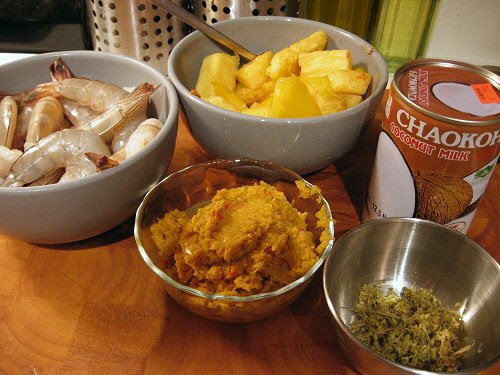
PrawncurryfixingsYeah, it's already Tuesday, but these things take time. This venture wasn't wholly a success, as is occasionally the case when I make Malaysian style curry pastes from scratch. I suspect that my ingredients (and much of those in the U.S.) just aren't the same as what you'd find in a tropical climate. Freshness is an issue for sure. And I wasn't about to make coconut milk from scratch like the original recipe called for, that's where I draw the line. But I had jumbo prawns and a pineapple (thank you, new Fairway) that needed to be eaten and my mind immediately went to S.E. Asia.

I'm always wary of the amount of shallots called for. Fifteen seemed a little outrageous, so I used maybe ten. The end result was very bitter and slightly medicinal, and I'm not sure if that was due to the shallots (I'm always paranoid that they're going moldy, but then I have a violently irrational fear of mold) or galangal or lemongrass (I've been using frozen) having gone bad. Now that I think about it, the problem might be that I don't use enough oil (I cut the three tablespoons down to two) at high enough heat and the paste never properly cooks because it stays too wet. Hence, raw tasting shallots, galangal and lemongrass.

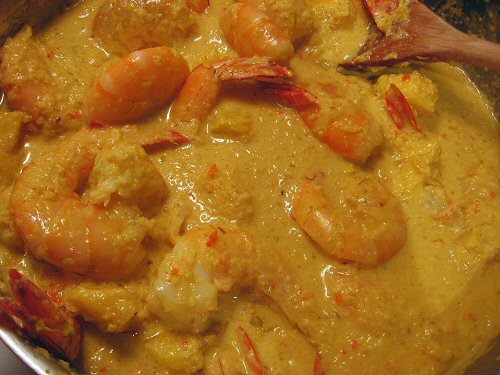
I ended up just picking the prawns out of the curry and eating them with my hands. I mean, you kind of have to to get the shells off anyway. There's no way I could let a meal go to waste. Well, unless it was moldy.

Prawn and Pineapple Curry

Ingredients
12 large prawns
2 tablespoons canola oil
2 stalks lemongrass, lightly crushed
½ small ripe pineapple, peeled and sliced
1/3 cup coconut cream (thick cream from top of an opened, unshaken can)
1 2/3 cup coconut milk (remaining left in can)
1 ½ teaspoons salt

Paste
8 red chiles
15 shallots, peeled
Galangal, 2" knob, peeled
Turmeric, 1" knob, peeled (I resorted to a teaspoon of ground spice)
Shrimp paste, 1" square piece
3 candlenuts

Wash prawns. Trim off feelers and legs. Leave unpeeled.

Heat oil in kuali or wok. Fry lemongrass and paste until fragrant and oil separates.

Add pineapple slices, then coconut milk. Bring to a slow boil and simmer gently for 5 minutes.

Put in prawns and simmer until almost cooked, then add coconut cream and salt. Simmer until thoroughly cooked.

Prawnpineapple

Adapted from Rasa Malaysia by Betty Saw. Marshall Cavendish. 2005.