Skip to content

Posts from the ‘What to Eat’ Category

El Anzuelo Fino

Even though I feel like they (whoever they are) have been saying it years, Peruvian is supposed to be the hot new cuisine (I’m torn, because as much as I love Peruvian food, I was hoping for Filipino to take that honor). Maybe so. And I’ll be waiting to see how NYC responds to the big, modern version at La Mar Cebicheria opening this week.

Meanwhile, I went small. I’m such a slave to Pio Pio that I never give any of the other Peruvian options on Northern Boulevard a chance. How many matador combos can one person eat before branching out? El Anzuelo Fino needed trying (El Sol does too).

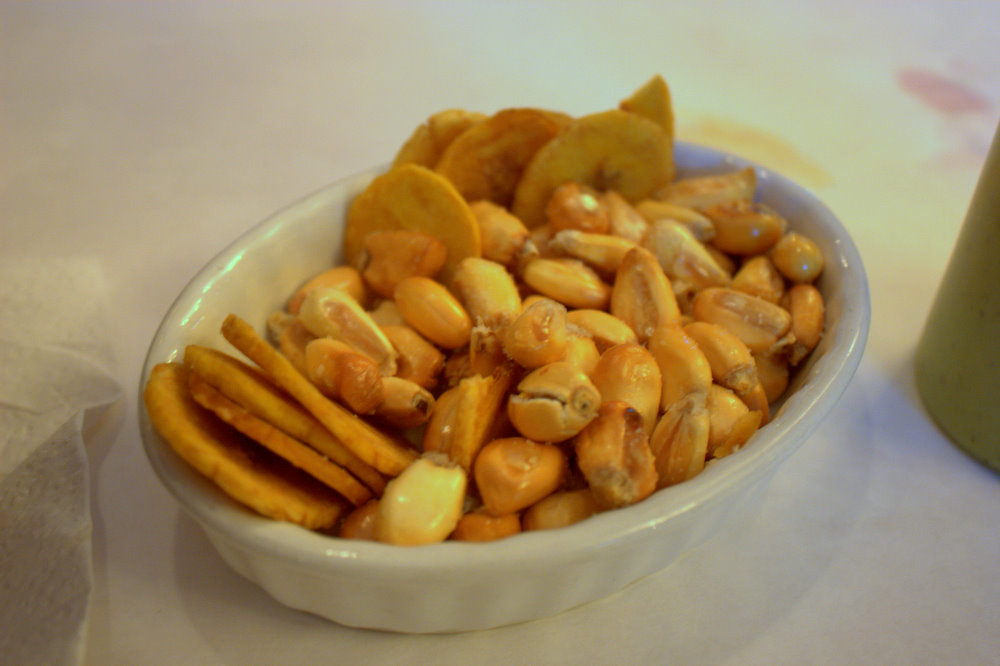
El anzuelo fino corn nuts

Gastón Acurio's curl-topped face was all over a travel/cooking show playing on the television in the front dining room. I wonder how much of a crossover audience will be shared between this small, Jackson Heights corner restaurant and La Mar Cebicheria?

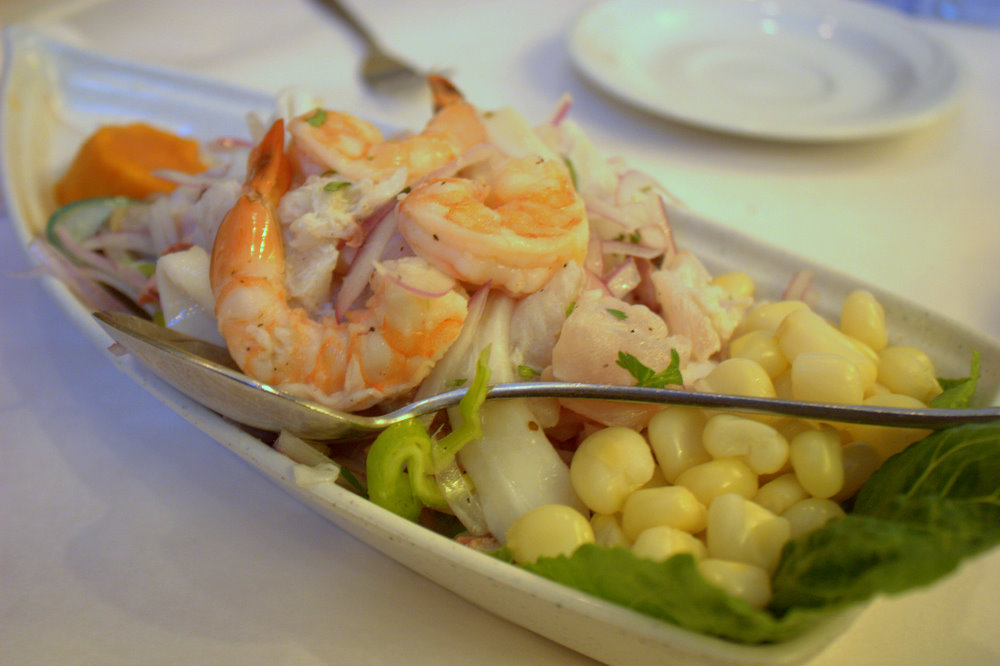
El anzuelo fino ceviche mixto

Ceviche mixto is always an accurate benchmark. Here, cubes of raw firm fish, likely corvina, shrimp, octopus rings and a single green-lipped mussel were the mix. This is the only restaurant where I’ve been asked about spice level and given a dish with a genuinely hot kick in addition to the lime’s tartness, which by itself can be one-note.

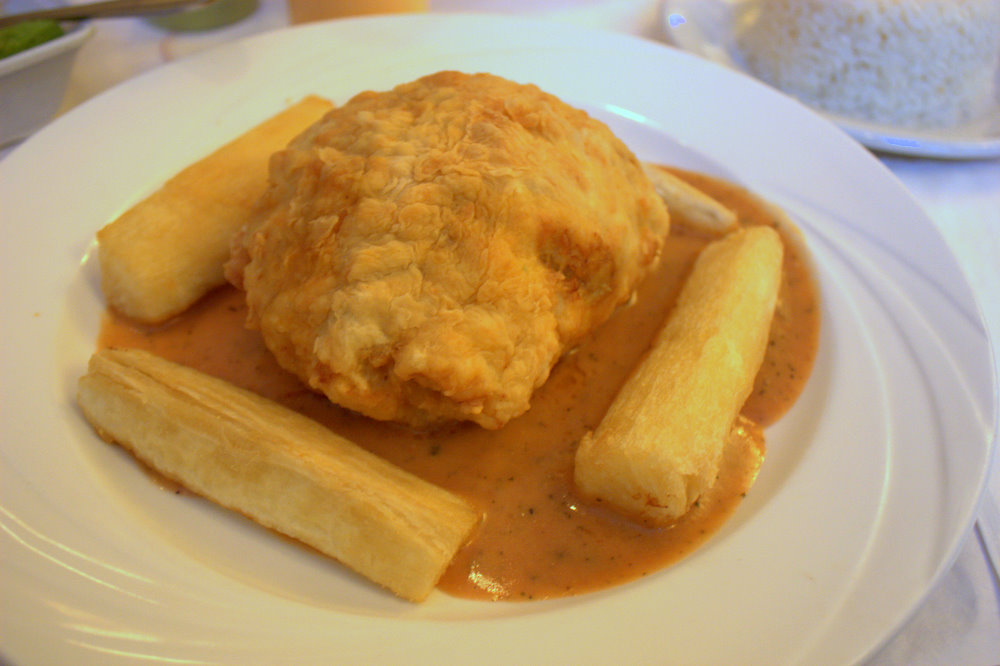
El anzuelo fino corvina rellena con mariscos

With fish hook in the name and a fish waiter logo, napkin draped over one fin and a plate of food on the other, nearly as cute as Pio Pio’s chick in clogs, seafood was in order. Red snapper seemed like too much for one, and my concession, one of the many corvina dishes, was not exactly light. The filet is fried and comes sculpted around a center of shrimp, mussels, and octopus (cooked ceviche mixto, essentially) in a creamy, lightly spicy sauce (that’s even better with a few squirts of the hot green sauce in a squeeze bottle that thankfully you don’t have to ask for). Surrounded by logs of yuca (and served with default white rice) this golden mound is not dainty, but the inevitable leftovers hold up well. Sure, I’ll eat a ball of seafood for breakfast.

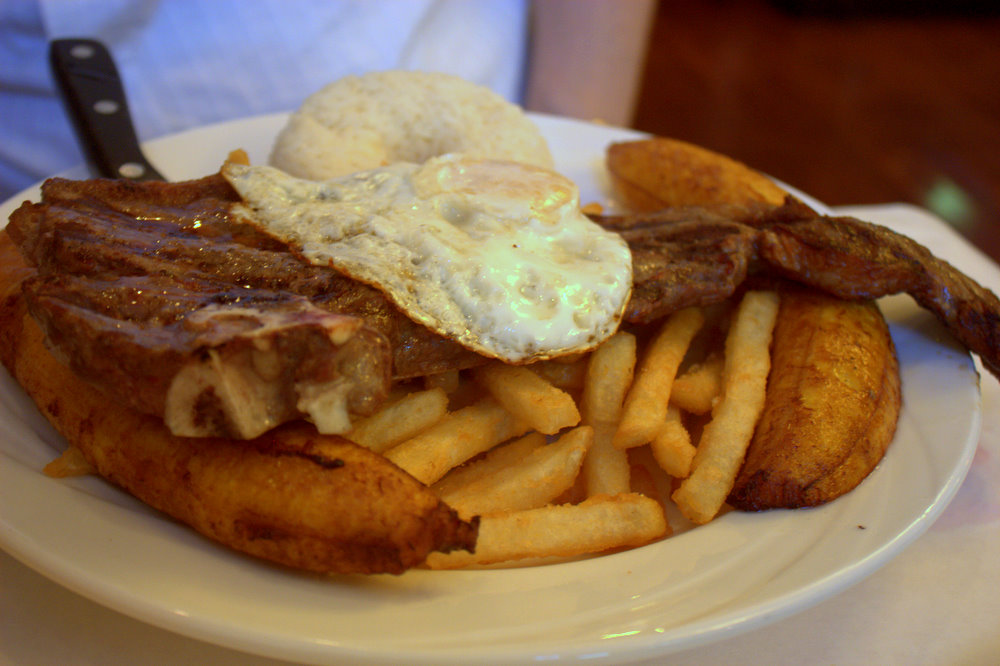
El anzuelo fino churrasco a lo pobre

Or you can order a sirloin steak, typically thin and well-done (ask for it rarer). Bistek a lo pobre with maduros, rice, fries and a runny-yolked egg is like breakfast for dinner.

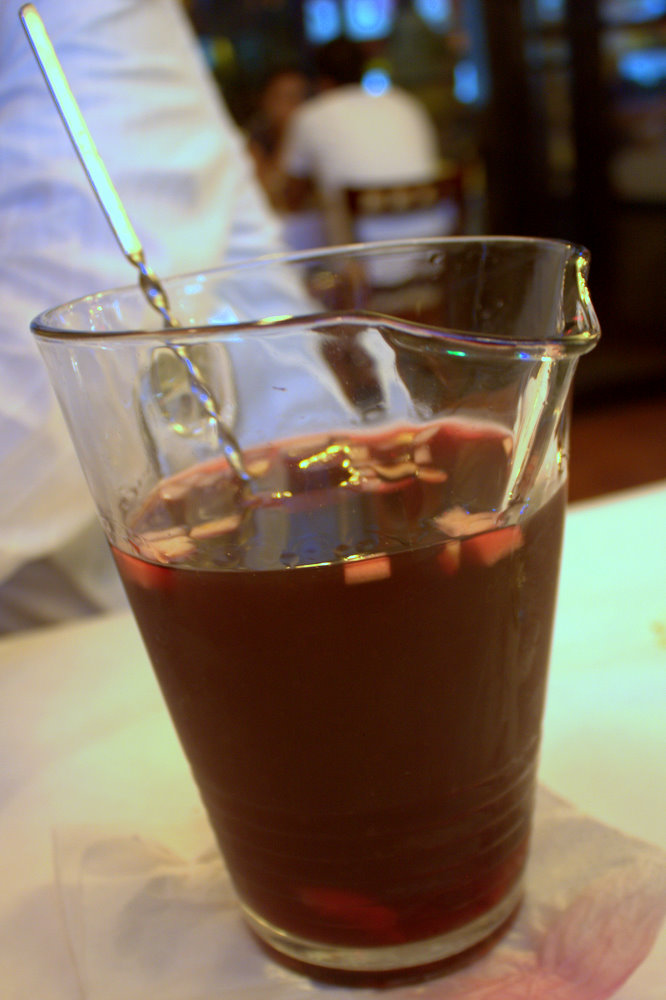
El anzuelo fino sangria

My original plan was a nightcap at Amaru, the newish pisco bar from Pio Pio (and in their old space) but after stiff two-for-one cocktails at The Astor Room and half of a pitcher of sangria, I wasn’t feeling the need for a Rocoto Sour—at least not with the two bouncers out front and thumping bass trying to escape the closed doors. Maybe on a weeknight.

El Anzuelo Fino * 86-01 Northern Blvd., Jackson Heights, NY

Blue Hill at Stone Barns

1/2 Even though school started this week and we’ve slogged through torrential downpours, September is still summer—and therefore, a perfectly good time of year to experience nature’s bounty of tomatoes, corn and melon (bah, more about that later) This particular month wasn’t part of my original plan, though.

There was no impetus for a trip to Blue Hill at Stone Barns beyond a July panic that I should be eating summer foods somewhere that takes such things seriously, i.e. not my home. My only two previous visits were in the dead of winter, so cold you had to run from the parking lot the entrance and missed the whole point of escaping NYC, and before they implemented the freeform, tasting menu-only approach. Eh, and I was violently sick and ruined my own meal last time. (Through no fault of the restaurant; I was getting over a two-week-long flu and didn’t want to cancel my reservation. That was a mistake.) It was time for a re-do. Except that the soonest weekend opening available was for Sunday, August 28 at 9:30pm. I took it anyway.

And when Hurricane Irene was predicted I thought I was being a genius by searching Open Table for cancellations. There were plenty. 5pm on a Saturday? No problem. Except that Saturday morning the restaurant closed. Wisely, it turned out, because even days later on a Thursday for our rescheduled dinner, the hour drive ended up taking three (!) because of the Saw Mill Parkway being closed, flooding and other unforeseen detours. (On the way back we were re-thwarted and discovered the Brooklyn Battery Tunnel was closed, then the Brooklyn Bridge entrance, too. 9/11 prep or normal construction, I don’t know. By the time I set foot in the apartment it was 3am.)

Being a weeknight (and having just eaten at Town House over Labor Day—two decadent parades of food just seemed a bit much for one week) we opted for the smallest number of dishes, five, which would presumably be plenty satisfying—and the right number for one bottle of wine, a 2004 Eitelsbacher Karthäuserhofberg Spätlese, preceded by a gin cocktail with purple basil and a glass of cava.

Bubbly always signals special occasion (and really, the restaurant’s three-and-half-year-old, new-to-me style is the epitome of special occasion dining—there were lots of candles sheltered in glass domes, brought to tables to be blown out) and we were asked if we were celebrating anything. We were not, though I would’ve been well within my rights to mention our twelve-year dating anniversary that occurred three days before. I’m not attention-starved.

No matter, the meal that unfolded was anniversary-worthy and then some. No restrictions, no allergies, no food off-limits. (Not 100% true—there’s only one food in the entire world that I don’t like but wouldn’t necessarily bring it up under the context of “Do you eat offal or mind raw seafood?” because it’s so benign to most that I can’t bear bringing it up out of fear of looking like a dilettante. Ok, I hate melon, yes even watermelon, and cantaloupe in particular. The offending fruit showed up three times during this meal! Because it’s still summer, duh. And yes, I ate it without complaint because I don’t tolerate food babies and no one should put up with crap from me either.)

Let’s just say that five courses was merely a guideline. The amount of food was highly unexpected, edible shock and awe, which I’m not complaining about. I just had not anticipated a four-hour dinner and closing down the restaurant. You have to be mentally and physically prepared for such decadence! And I’m still sad about leaving behind a good portion of the final savory course: pork in a zillion forms—especially after hearing about how cute and fat the piglets were getting.
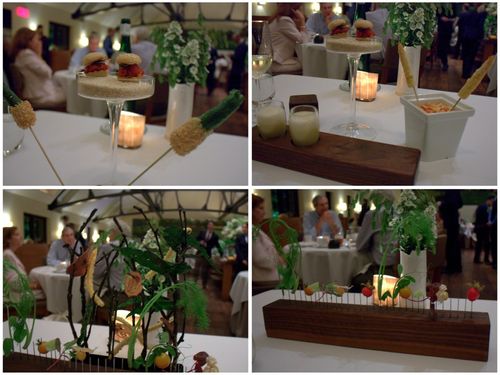
Blue hill stone barns 4 amuses

The meal was kicked off with a single lettuce leaf (a similar one-leaf approach occurred at Town House the previous weekend). Then you’re consumed by which naked piece of produce to snatch from the row of metal spikes first, though soon your attention is diverted by a jungle of dried kale, tempura beans and thin rounds of pancetta.

The mini burgers are a diminutive hallmark; beets in the past, this time with tomato and bacon. And a really sweet bun, which I liked. Keeping up the make-the-diner-feel-like-a-giant theme, finger-sized zucchini and “corn dogs,” battered, fried little stalks served with a bitter corn and beer shot, added to the tableau.
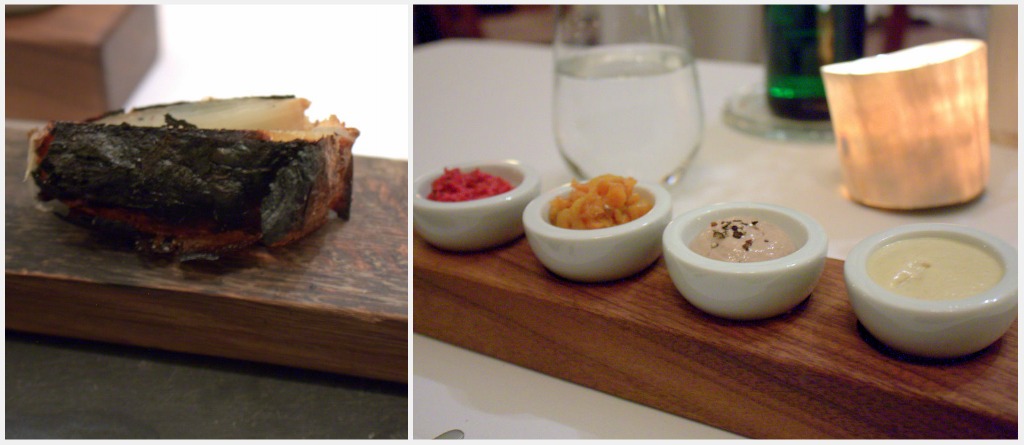
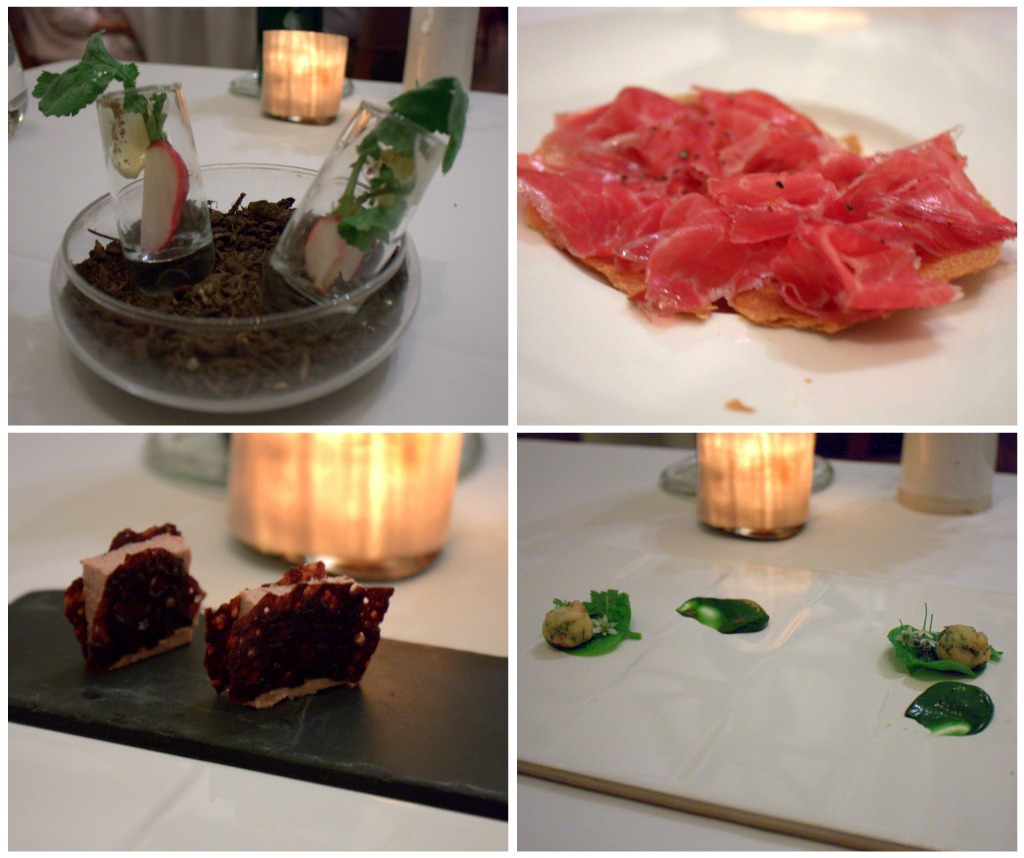
   Blue hill stone barns radish trio

Natural sweetness enhanced by salt was the theme. I never get people, always food people, who cite radish and butter sandwiches as a revelatory dish. Use fresh enough butter and barely bitter radishes and a good dose of salt…and ok, it makes more sense.

A coca, that would be a Barcelonan thin, crackly near-pizza (I only know this because twice I went to La Vinya del Senyor looking for a version with red peppers and sugar and both times they did not have it) comes blanketed with cured ham.

Fish balls with phytoplankton mayonnaise. What’s phytoplankton, you ask? Microscopic organisms that form the basis aquatic life. Dan Barber encountered its culinary applications at Aponiente in Cádiz. Will powdered, reconstituted algae be the next shredded beef tongue?

My subconscious must be stronger than realized because I have no photographic evidence of the melon balls with cracked pepper and watermelon juice course. If forced to choose, I will concede that watermelon is the more tolerable variety.
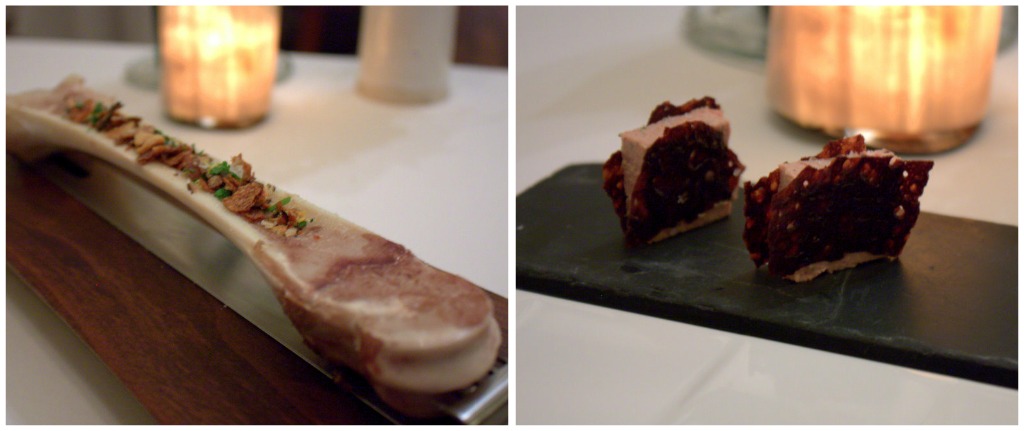
Blue hill stone barns marrow duo

The garden showcase segues into a meaty period with a veal marrow bone (love the tailor-made contraption) topped with breadcrumbs and foie gras sandwiched between lacy chocolate wafers.

It’s hard to say where the amuses end and the courses begin.
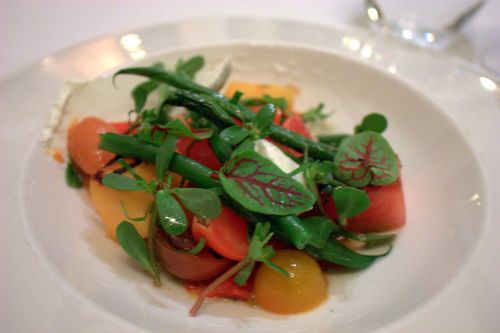
 

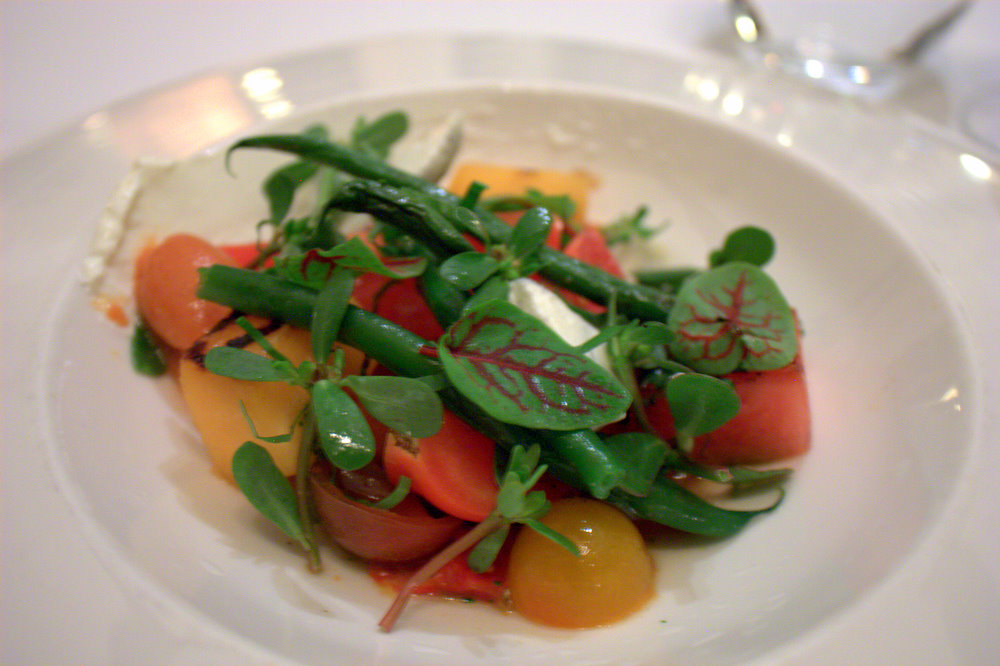
Blue hill stone barns tomatoes & melon
More melon! I will also concede that grilling the bad-sweet pink cubes adds a complexity that paired well with good-sweet tomatoes and a touch of goat cheese.
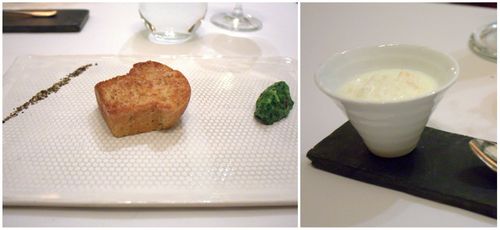
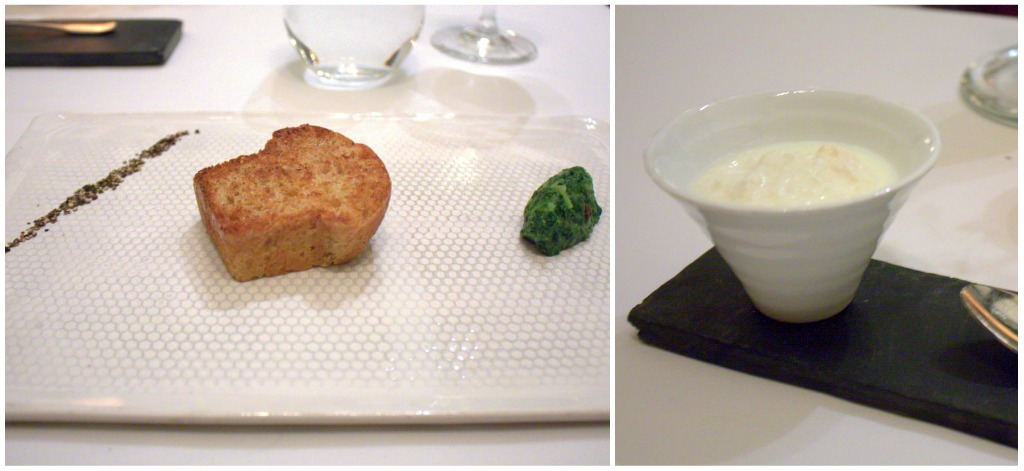
Blue hill stone barns brioche duo

Ricotta is stirred into solidity tableside and is meant to be eaten with a thick piece of brioche and a mound of greens (spinach? chard?). I’m pretty sure tiny raisins were tucked into the sautéed vegetable.
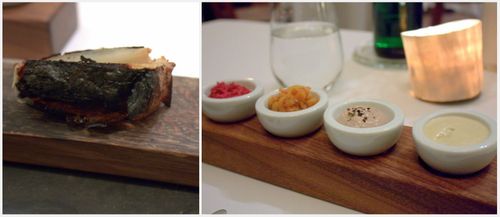
Blue hill stone barns onion duo

We wondered if the wild flames visible through a darkened window were intentional (after the flooding and hurricanes, who knew?) Yes, and our onions cooked in “biochar” were one of the things in the fire pit. The soft, caramelized guts could be eaten with a hazelnut-leek spread, chicken liver, peaches or beets. The latter may have worked the best, but I loved the variety.
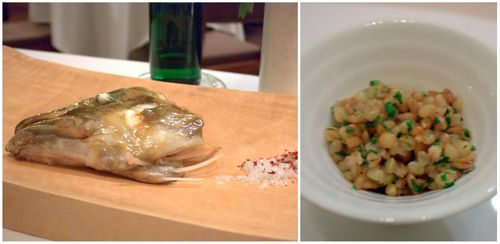
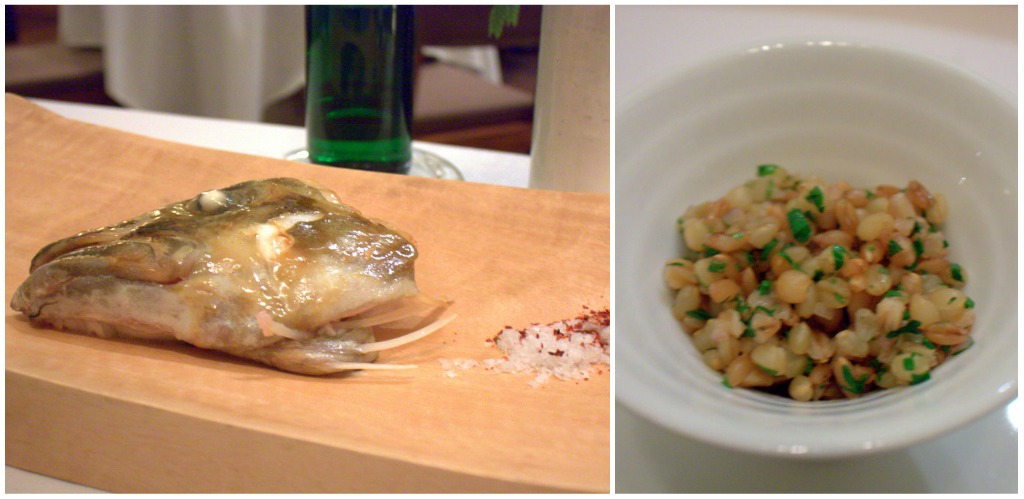
Blue hill stone barns head grains

Hmm…when the chopsticks appeared I wondered what was coming. I didn’t notice anything particularly Asian on the tables nearby. Fish head? Indeed! I was not expecting a nice gelatinous piece of cod simply presented with a pile of salt and chile flakes for flavor and to be eaten with a small vessel of grains. (I could not tell you the myriad varieties, though our informative server definitely would’ve found out, if asked.)
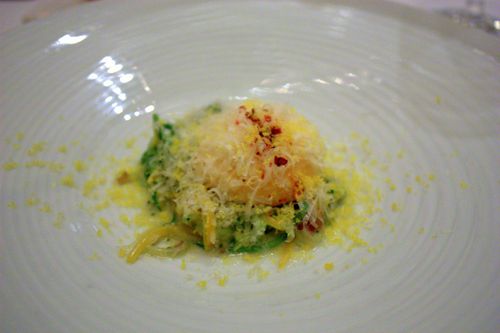
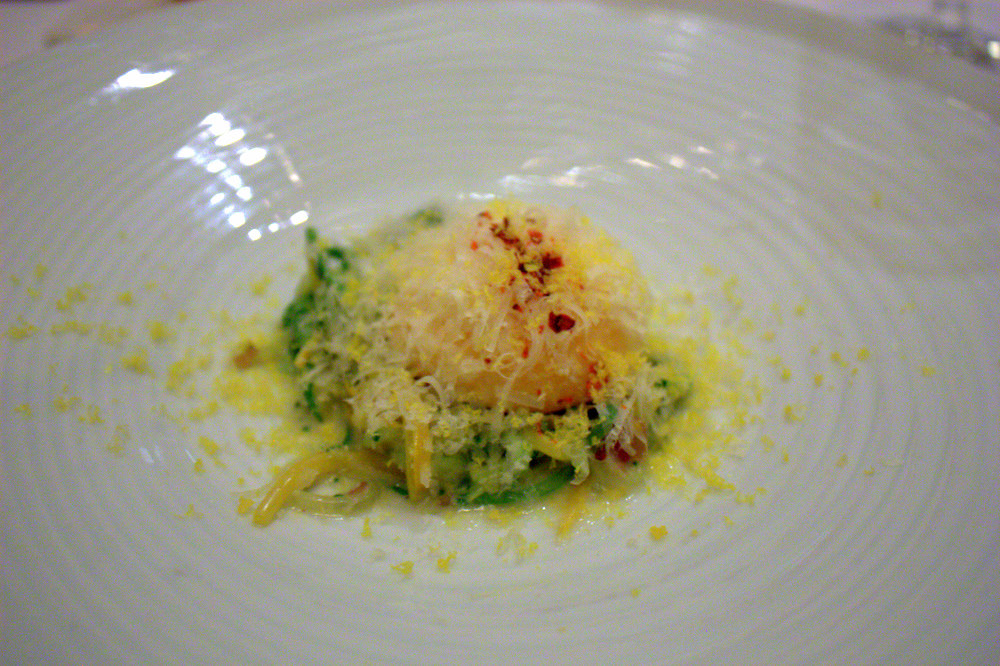
Blue hill stone barns egg

This is no mere egg yolk sitting atop zucchini shreds. An unborn egg aged to the texture of parmesan is treated similarly to the hard Italian cheese and is grated on top. Egg two-ways. Thankfully, the fish head was as wild as they got and balut wasn’t incorporated for a three-way.
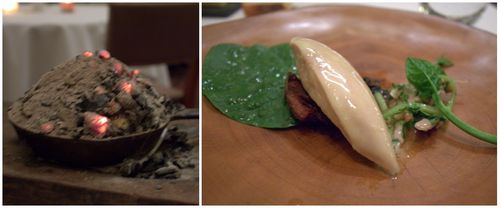
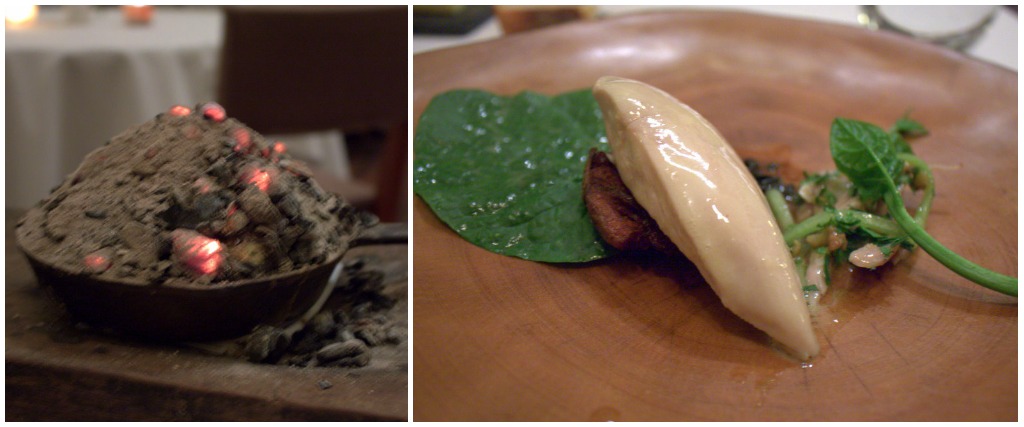
Blue hill stone barns salt baked duo

Salt-baked chicken in a charred crust. I have to admit I was feeling a bit fatigued by this point, so I didn’t ask about the chicken that James insisted was seasoned with pork. Was it? The pristine flesh has clearly been glazed with something.The fried potato dish beneath had to have been. The flavor of the meat was so intense and savory that if only derived from the poultry itself I will begin ponying up for the farm-raised chickens I’m normally too cheap to indulge in.
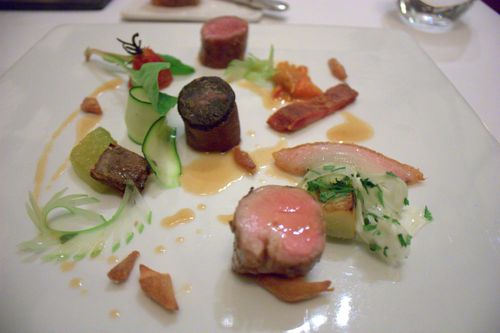
Blue hill stone barns pork

Waah, pork…rich, fatty pork. Why did it have to come at the end? I was only able to handle a few bites from this sampler of  bacon, blood sausage, ears, loin and even little chicharrones. (I’d just stocked up on pork skins at gas stations all over North Carolina so my pork tolerance is high.)
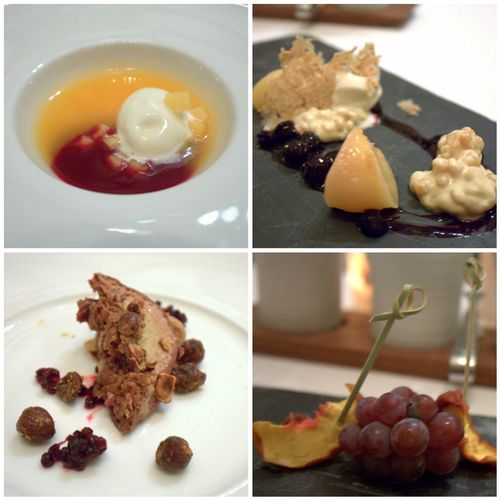
Blue hill stone barns sweets

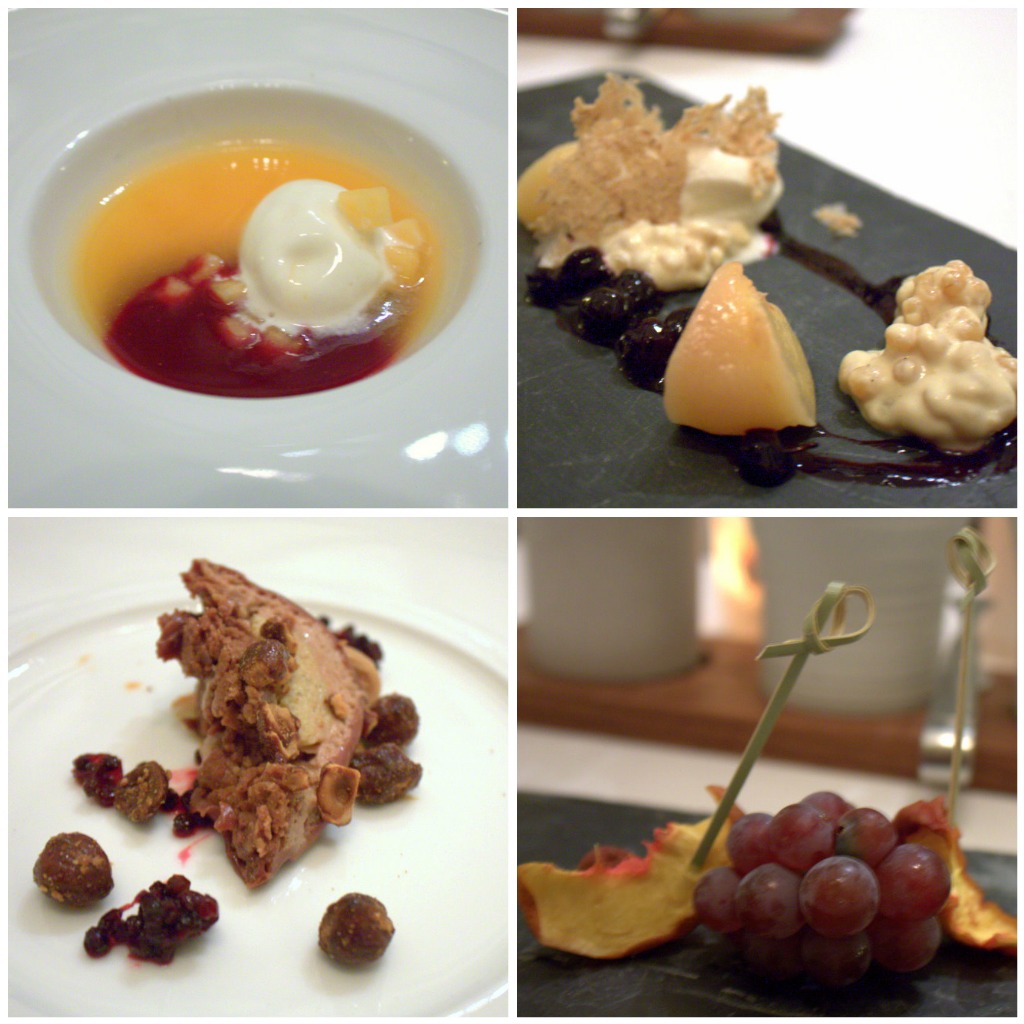
Nothing like a cantaloupe palate cleanser, cut with concord grapes (phew) to transition to the sweeter side. This was followed by a semolina pudding with blueberries (and plums?), a chocolate hazelnut mousse with elderberries and an ender nearly as simple as the initial lettuce leaf: dried white peaches and a cluster of grapes.

The restaurant has really elevated its style—the ethos is produce-forward, but more accessible and soothing than some of the forage-heavy roots-leaves-and-twigs school that’s in vogue—since my long-ago last visit. It feels very American. I wonder what influence Peru will have on the cuisine’s future. We were told that “Dan was in the city” before being offered a peek into the kitchen. What they didn’t say was that the city was Lima.

Blue Hill at Stone Barns * 630 Bedford Rd., Pocantico Hills, NY

Castagna

I’m moderately embarrassed to admit that I have always glossed over any mentions of Castagna because I incorrectly assumed it was an Italian restaurant (it once was). Only after Castagna started affecting me directly, i.e. appearing in my heavily NYC-loaded rss feeds because the young chef, Matthew Lightner, was leaving to work at Tribeca’s retooled Compose, now to be known as Atera. My week in Portland was the chef’s final week in Castagna’s kitchen. Now I was motivated.

And he’s a total forage-crazed adherent to the new Nordic ethos (with a good measure of Spanish avant-garde tossed in, as I soon discovered). Ok, as long as he wasn’t going nuts with pine needles, wet moss, slugs and mushrooms, my Northwest bugaboos, I was up for this. I imagined Castagna as a counterpoint to Paley’s. Warm and homey versus cool and rustically cerebral.

Castagna facade
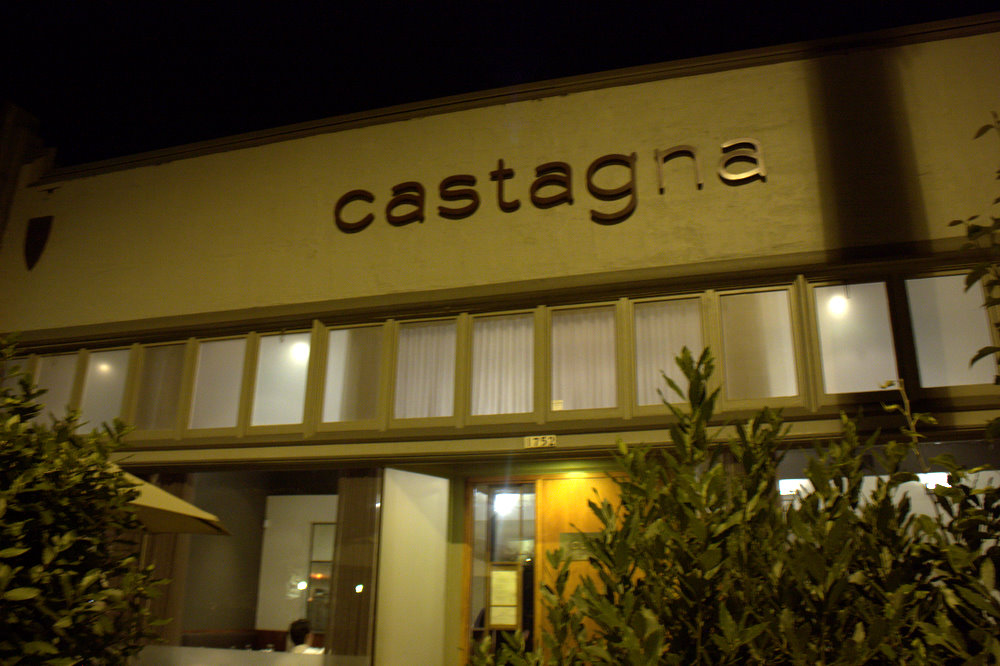
Castagna is designed in style that’s similar to one that's taken Portland by storm during my long absence. There is a regional penchant for turning existing structures into modern glassy boxes done in neutral tones, metal signage and light wood, very Scandinavian with a touch of the Northwest by which I mean ramshackle despite no ragged edges; it’s just a haphazard feeling I get and not visible to the eye. Castagna is less stark from the outside because it's housed in a deco building.

I first noticed this on my last visit two years ago when I realized Laurelhurst Market was a kitted out former Plaid Pantry. This trip, I tracked down a bottle of La Passion de Juchepie wine mentioned in The Art of Eating just because it was described as “so rare as to be almost unobtainable in the United States” yet there was one bottle left at Garrison’s Fine Wines in Portland.

This wine shop was in a shiny, newish strip mall, aesthetically acceptable with its clean lines, wood panels and earth tones that would presumably keep tanning salons and 99-cent stores at bay. This collection of shops was on the former site of a dumpy grocery store that I want to say was called Thrifty Mart, but probably wasn’t. It was my first supermarket after moving out of the house (eight blocks away). Feeling flush with newly granted food stamps ($112 per month seemed like a lot of money) on my inaugural visit I picked up hot cross buns because I’d never eaten the sweet rolls topped with candied fruit and icing and smoked salmon because it seemed fancy. And now you can spend $48 for a half-bottle of obscure imported French dessert wine on its grounds.

No one was wearing fleece or polos in Castagna. Women wore makeup. Two men were dining solo doing full tasting menus. This is where I’d want to say, “you could be anywhere,” but not really. It felt American still, West Coat most likely. The space was far too airy, relaxed and non-bustling to be New York or even Brooklyn despite a tempered hipness.  The background music was so quiet that Shazzam couldn’t even pick up the noise and help me jog my memory to identify a song (it came to me later: The xx’s "Islands"). It felt like a cosmopolitan restaurant in Portland, frankly. The city could use more of these.

We did not do the tasting. One parade of decadence was plenty for one week, and Benu already took that spot. We still received a fair number of dishes before we got into the four-course prixe fixe (a great NYC value at $65, though perhaps high for Portland—I don’t know any locals who’ve eaten at Castagna). If I wasn’t sure what I was getting into, I certainly did after the initial trio of snacks: thoughtful, precise flavor combinations; a little Nordic, a little unexpected, very woodsy.

Castagna snacks

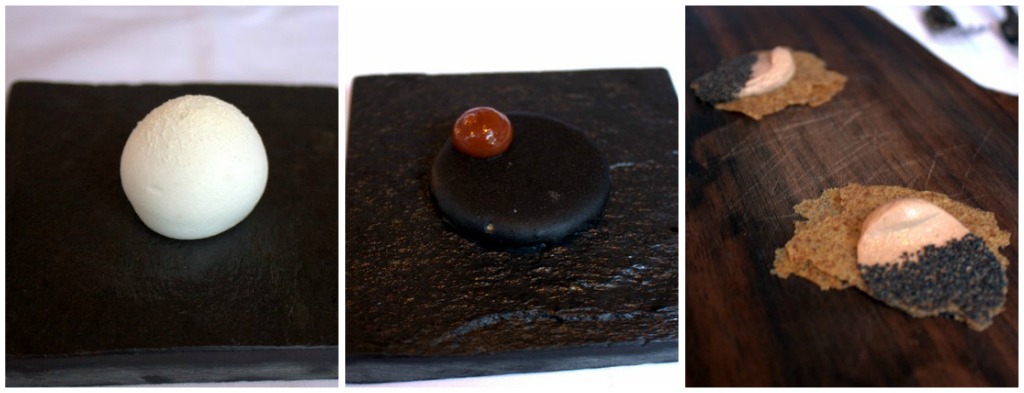
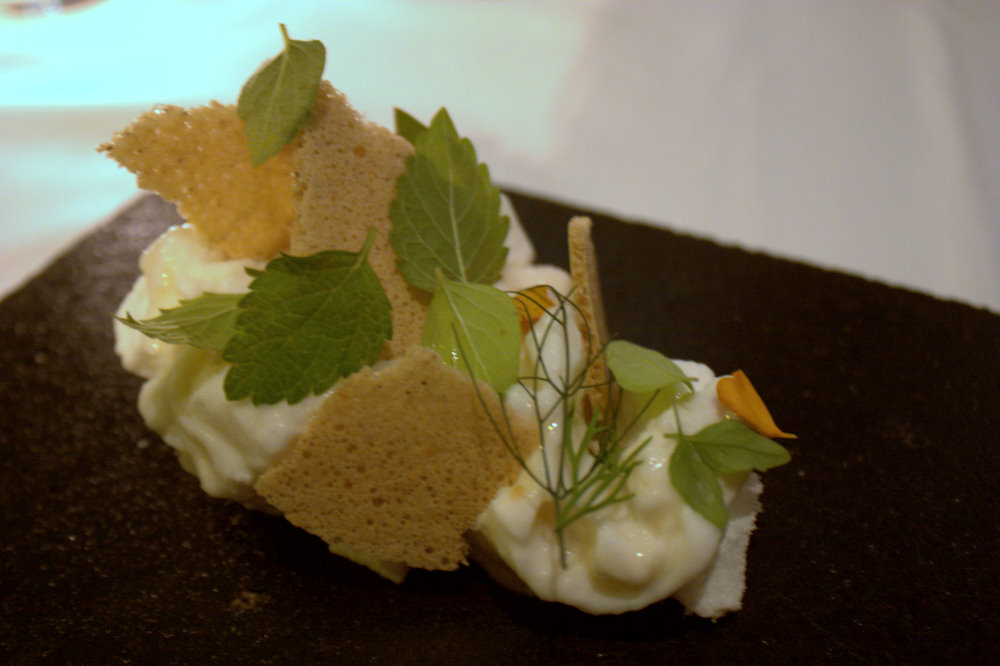
A puff of meringue filled with a bright green herbal mousse. What looked like a Girl Scout Thin Mint was a savory cracker coated in slightly bitter black sesame paste, perfect with a dab of tart rose hip jam. Rye crackers with chicken liver mousse and poppyseeds.

Castagna bread and butter

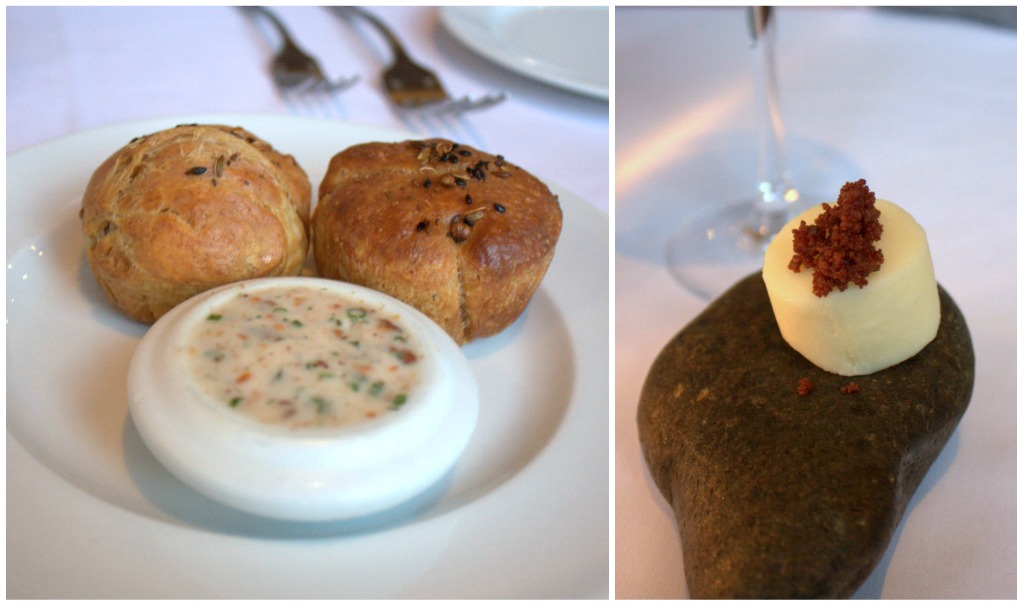
The butter topped with brown butter solids was nice, and more attractive perched on that rock, but the lardo studded with herbs and I want to say bacon was insane. So insane that we ate the whole thing and were brought a second little dish. The rye rolls were very sturdy, a good match for the smoky, spreadable fat. This would be so good paired with a scotch-based cocktail (maybe I shouldn’t be giving that other Portland expat chef any ideas).

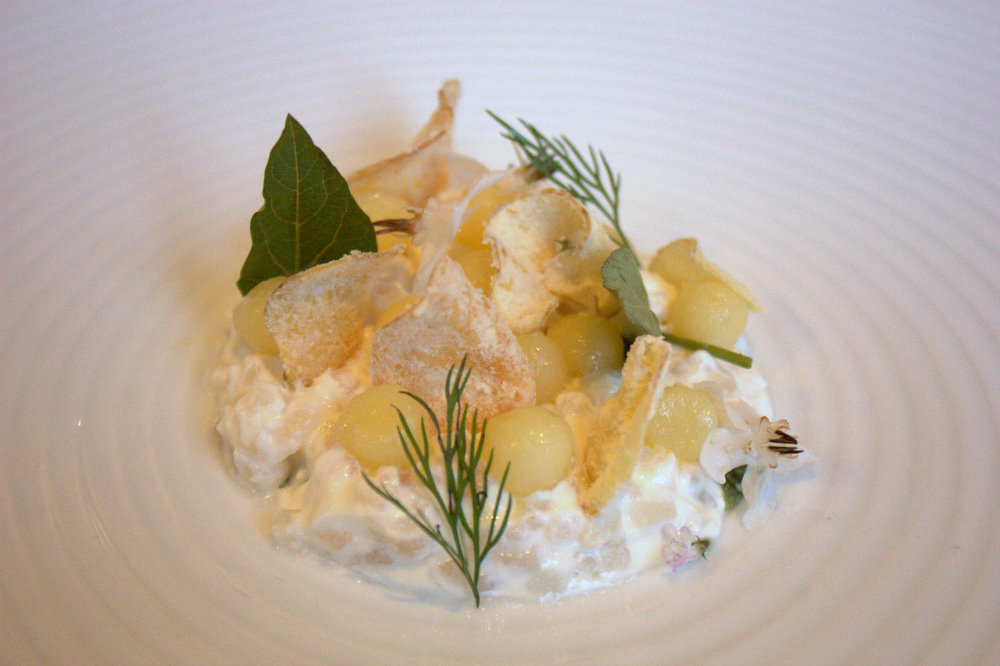
Castagna black cod with pickled potatoes, sour cream, dill, borage

black cod with pickled potatoes, sour cream, dill, borage. Potato chips! The cod, chopped into small pieces and bound with sour cream reminded me of a more compelling tuna tartare; you know, the kind served with fried wonton strips and possibly served in a martini glass. Maybe this will be an ubiquitous starter in 15 years.

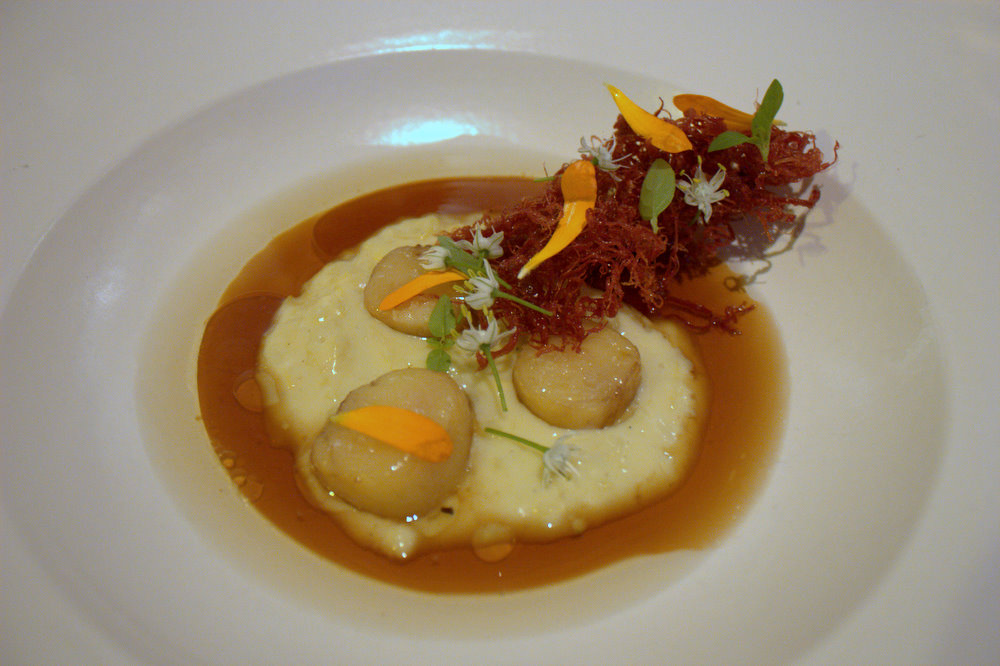
Castagna summer squash with beef marrow, tongue, onion blossom

summer squash with beef marrow, tongue, onion blossom. It was the marrow that grabbed my attention on the menu—and presented in rounds like scallops, no less—but it was the beef tongue that got me thinking. I just ate sous-vided, tweezered-painstakingly-by-hand-into-shreds tongue garnished with flowers at Mugaritz in May. Matthew Lighter worked at Mugaritz. Would this be called an homage? Is it taking too much from the original? The duo next to us asked and was given a detailed description of how the tongue was prepared, and they were delighted with the chef’s whimsy. Is it fair to not disclose the inspiration? Certainly, the tangle of meat floss was only one component of a more complex dish. It did make me wonder what I might recognize on the plates if I had had the good fortune of eating at Noma.

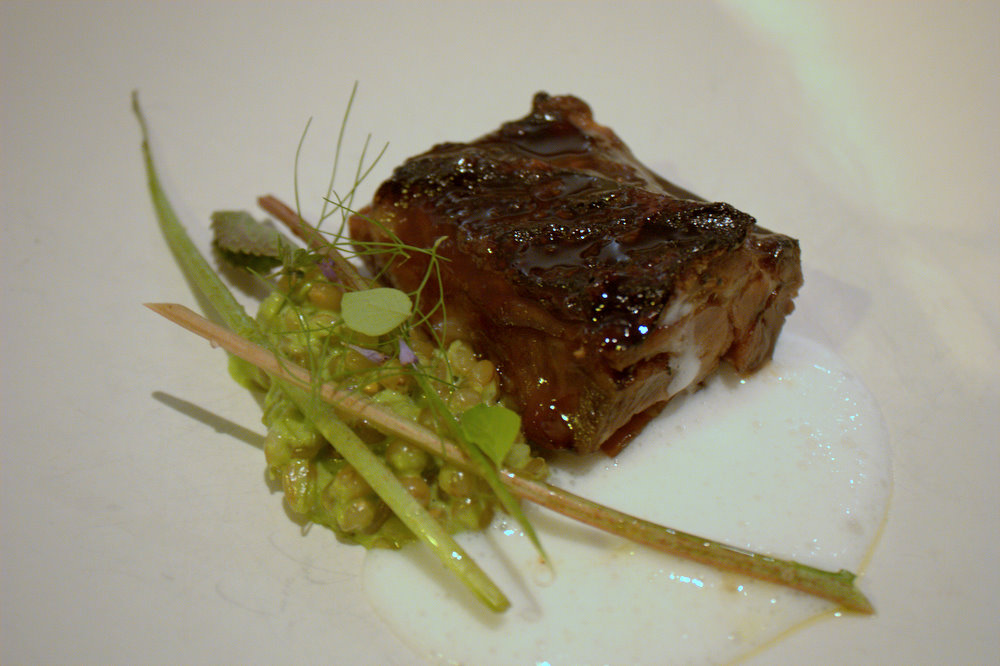
Castagna lamb collar, wheat berries, wheat grass, buttermilk

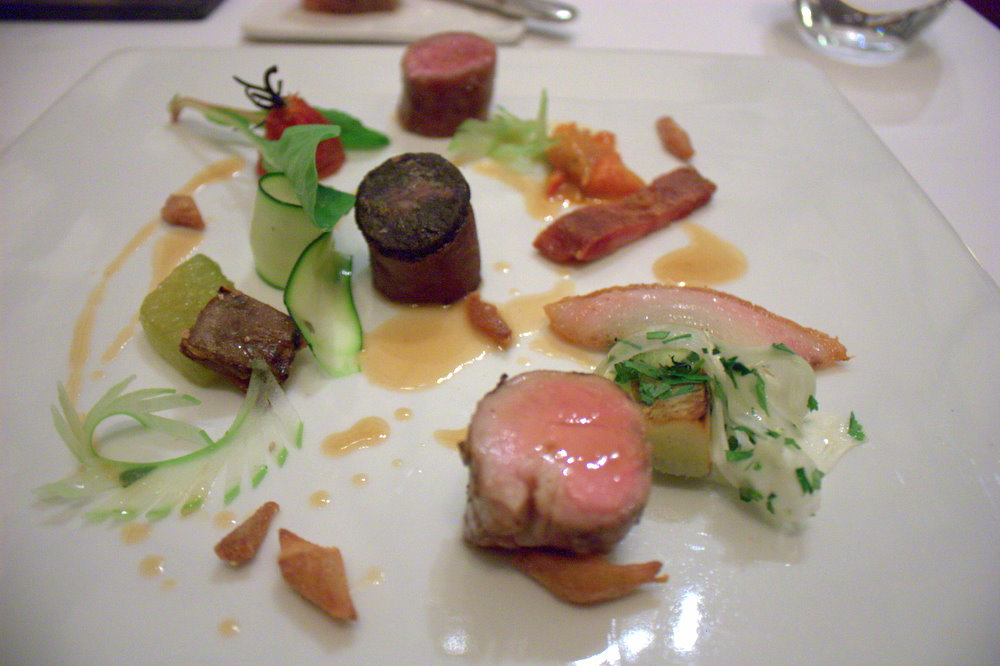
lamb collar, wheat berries, wheat grass, buttermilk. I was eating sticks–woody, lemony twigs–and that was not the only distinct texture; the wheat berries had a lot of pleasant chew. The fall-apart tender cut of lamb, glazed with a vaguely bbq-ish sauce, needed these stiffer accents to bolster it.

Castagna wild ginger with long pepper, ginger shortbread, herbs

wild ginger with long pepper, ginger shortbread, herbs. This was barely a dessert, spiced to the hilt with only the slightest hint of sweetness. Totally un-American, and mildly cruel, crafting this dish would definitely keep an herb chef busy. The pepper and ginger so intense that you almost get that Sichuan peppercorn overload where your mouth’s sensors give up and it almost tastes like you’ve been eating curried dirt. It’s the one item from this meal I ate over a month ago that is still tangible, I can taste the sharp, musty flavors even now. Am I selling this dessert or what?

I never felt compelled to try the short-lived Compose, but now I’m genuinely curious about Atera. Will there be beef tongue?

Full set of Castagna photos.

Castagna
* 1752 Hawthorne Blvd., Portland, OR

Paley’s Place

I’m not sure if this is a Portland vs New York City thing or a Way We Live Now thing, but when I lived in Portland—up until the age of 25—I ate things like burritos, monte cristo sandwiches and pizza (well, laska too) if I ate out at all. Late night Montage with their leftovers wrapped into foil swans was as fancy as it got. I drank Rainer Beer and whisky sours. Based on daily Twitter skimming, it would appear that it is not uncommon for young adults in NYC to imbibe $14 cocktails, bottles of 20-year-old Oregon Pinot Noir and eat foraged purslane salads and aged, grass-fed beef on a regular basis.

Maybe we just have more choice…maybe it’s just the money flowing in NYC. There’s a reason why food cart culture has flourished in Portland, after all. I didn’t see anyone obviously under 30 eating at any of the city’s high end restaurants during my visit.

Then again, we didn’t have a lot of “nice” restaurants in Portland when I was growing up. The city gets plenty of attention for its food now, but it’s not like there is a Per Se or Le Bernadin (Portlanders still don’t really eat fish) equivalent. In my era, Northwest Portland was the most expensive neighborhoods (I only paid $225 per month because the building could be demolished at any moment, a threat that had been present for years and came to pass not long after I moved in) and that’s where restaurants emerged that were acclaimed at the time: Wildwood, which is still going, and long-gone Zefiro, which stuck out on a stretch of taverns and delis with its soft glow emanating from a wall of windows polished and full of successful adults, it was the ultimate yuppie restaurant. I had no idea what kind of food they even served and would never bother getting close enough to check.

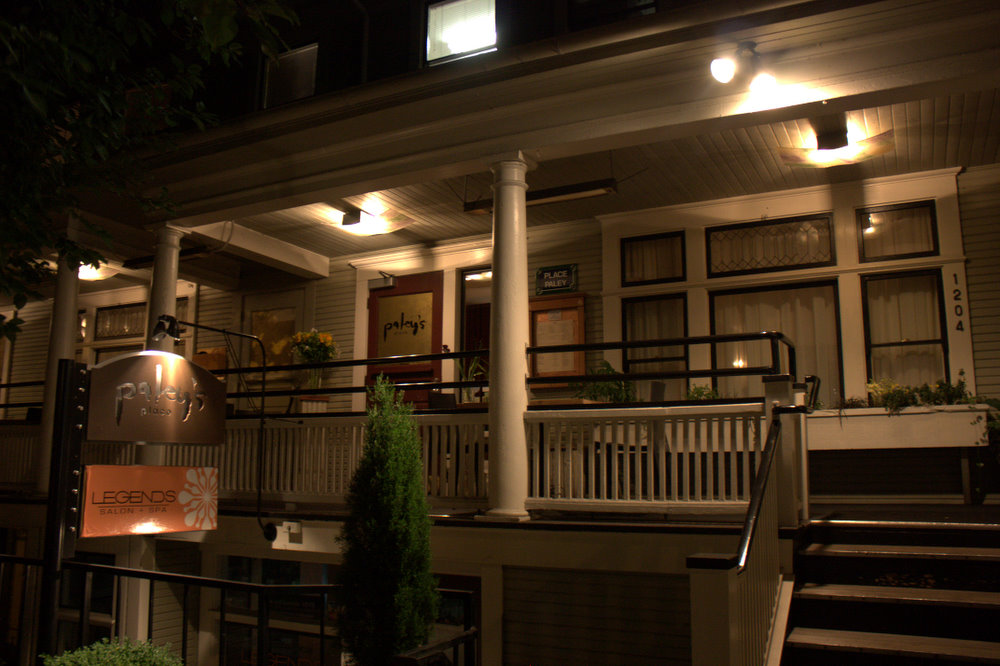
Paley’s Place, opened in 1995, was one of these novel-at-the-time local and seasonal restaurants that it never occurred to me to try. And did I want to now? It seemed kind of passé compared to on-trend Castagna or any number of young cheffy places in neighborhoods that no one would’ve traveled to to eat 15 years ago. But it’s an important restaurant and epitomizes old Portland, by which I mean late last century—things changed post-millennium as an influx of transplants and loftier ambitions began creating the Portlandia of today.

Paley's place exterior

Classic Portland translates to homey, literally, a wood frame house with a wide porch for al fresco dining. The interior is simple, warm; I’m remember drapes and carpeting even though I can see hardwood floors in photos. Despite the reputation as being a special occasion restaurant—it wins votes for Most Romantic and If I Won the Lottery, This is the First Place I’d Eat—suited for anniversaries or where your parents might take you out of they did that sort of thing (mine don’t) or where you might take them if you’re the flush one (maybe I’m doing better than I realize because I didn’t consider the prices lottery-winner steep) the diners were classic Portland, as well. Men wear neither jackets nor ties, but rather shorts and sandals. The servers themselves wear khakis and polos. Babies are breastfed at the table. Formality is an abstract concept.

The food, the whole point really, was completely solid. I chose not to stick with an appetizer/entrée approach, and you don’t have to; many items are available in half portions or aren’t course-specific.

Paley's place seafood sausage

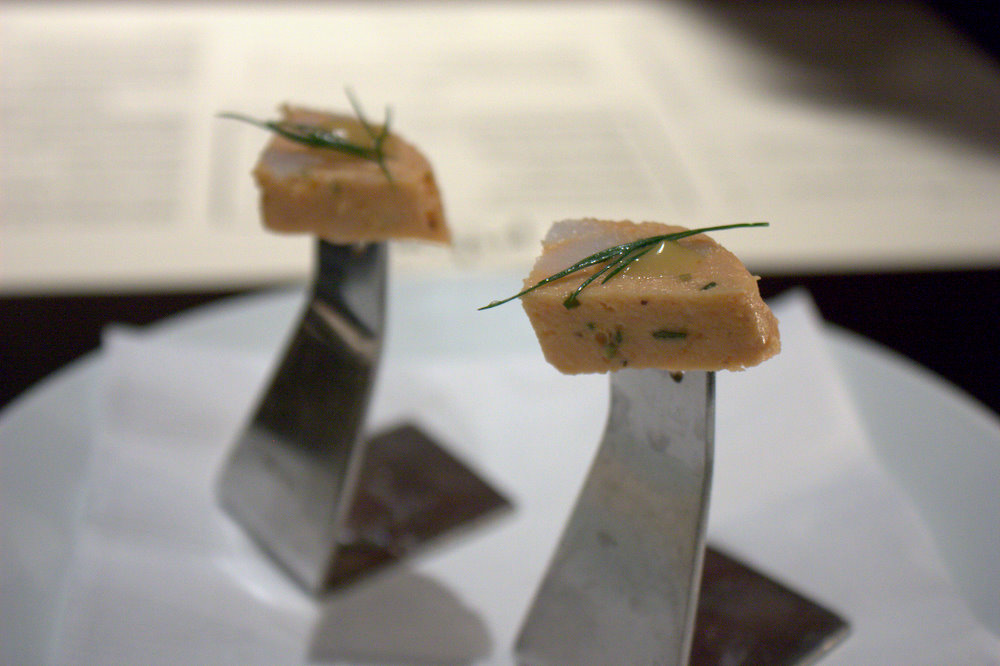
Seafood sausage amuse.

Paley's place oysters

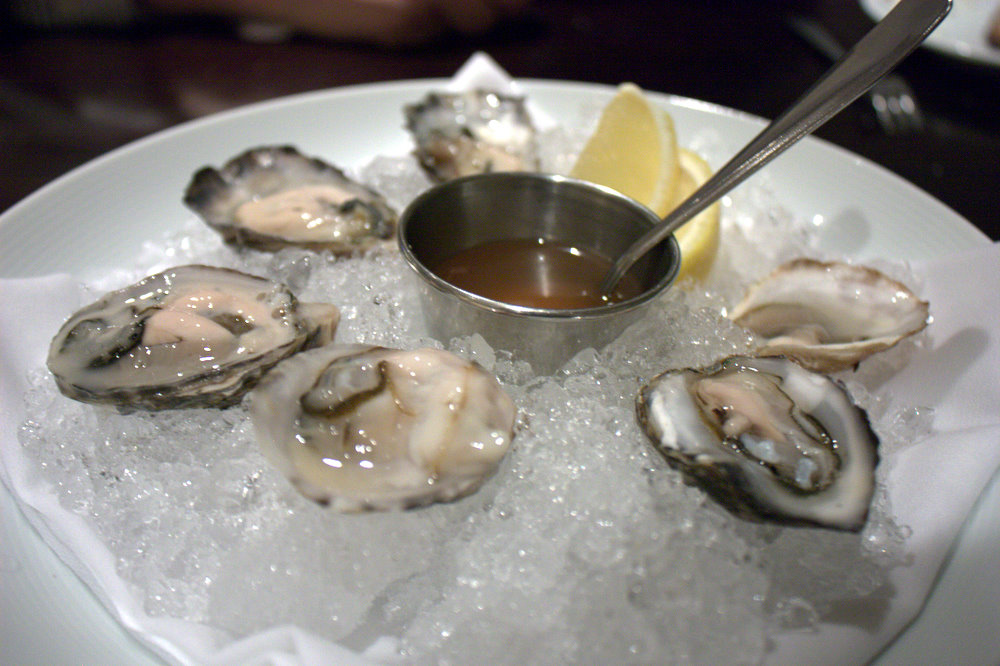
There were three different oysters on offer, all from Washington State: Blue Pool, Diamond Point and Kusshi.

Paley's place wagyu pastrami

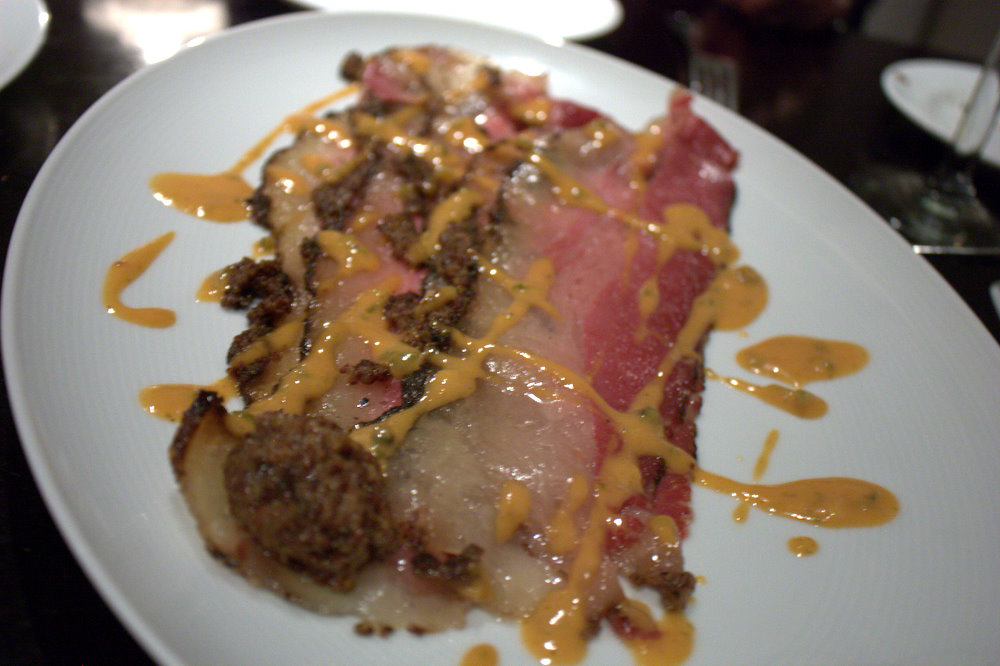
Wagyu pastrami might not look pretty on the plate, but it was a delicious, smoky, fatty mess. Extravagant without being dainty, there were hints of brown sugar complemented by both stone ground mustard and thousand island dressing. I wondered if Paley’s other charcuterie—there were at least ten types listed—excelled, as well.

Paley's place pork belly & sweetbreads

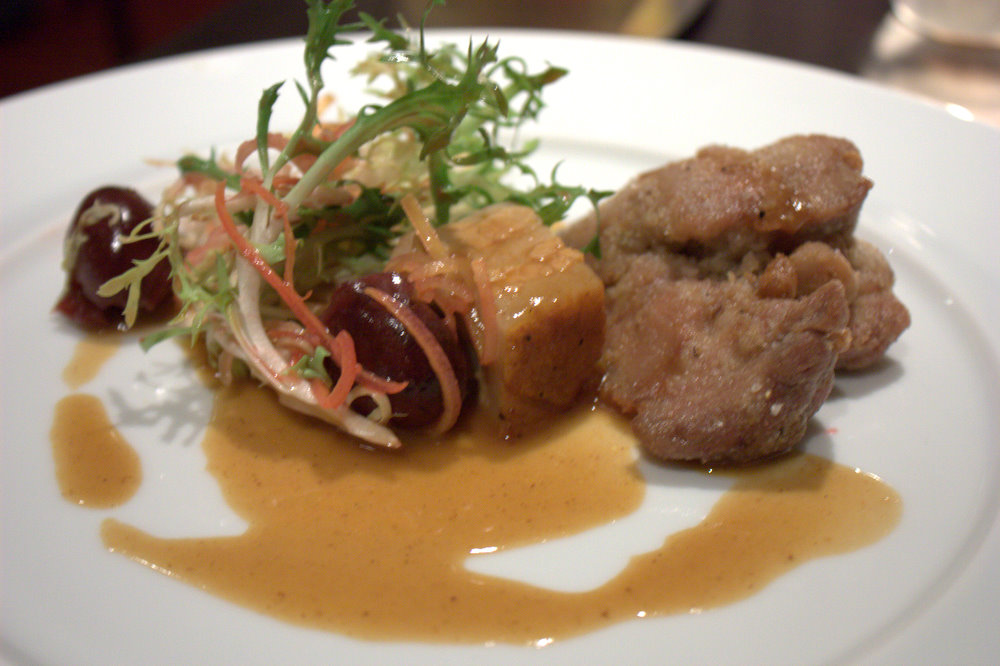
More shared richness in the form of a pork belly cube and pan-fried sweetbreads.

Paley's place salmon with aioli

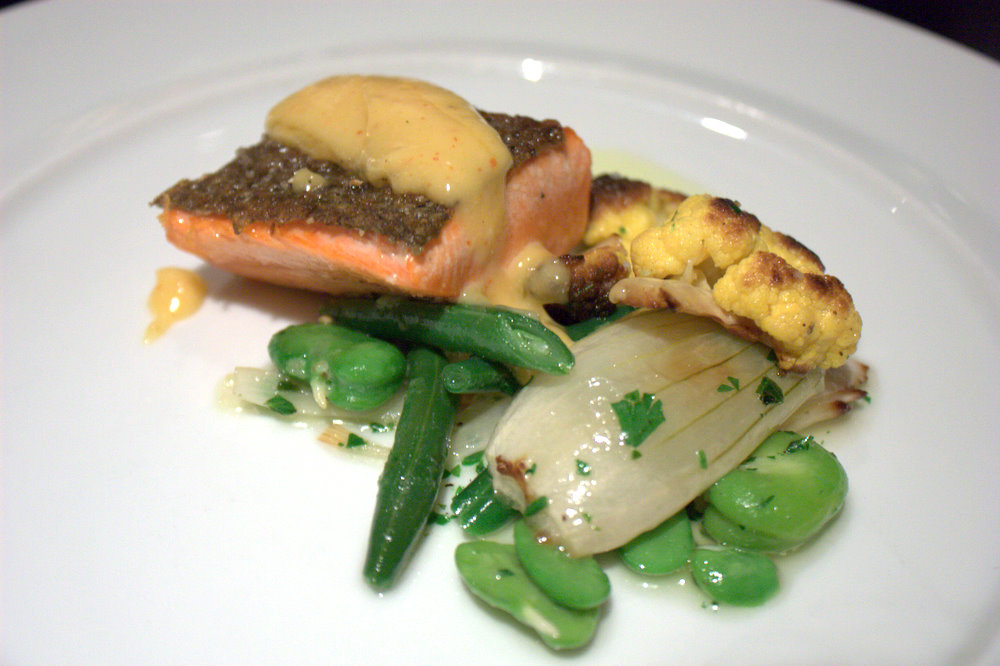
The 3-ounce half-portion of salmon turned out to be just enough when combined with the above dishes. Normally, I stay away from salmon because it seems dull, but it would be silly to avoid a Northwest fish so close to home. The charred cauliflower and saffron aioli gave a nice Spanish luster to the dish.

I was glad that I didn’t skip Paley’s in a quest for the latest thing. I had a reservation for Castagna the following night (so did a woman at the table of men in sandals) and was eager to compare old Portland to the new.

Paley’s Place * 1204 NW 21st Ave., Portland, OR


Bar Tartine

I managed to take part in Bon Appetit’s so-called “Germanic cuisine boom” in San Francisco despite having a contender two blocks from my apartment (two more days in Portland and I totally would’ve ended up at Gruner too). These things happen.

Bar Tartine struck me as more Austro-Hungarian than purely German. Some might say Cal-Hungarian. I wouldn’t, but that’s my aversion to the Cal prefix. James took to calling the hey-that’s-cool Bay Area style “Cal-tude,” which started getting on my nerves (him saying it more than the practice) but the service here was so careless and forgetful—we were given a free blueberry dessert, to be fair—that I kind of had to agree in this case. Cal-tude is not the same as the haphazard style that’s rampant in aggressively homespun/quirky Brooklyn restaurants because the venues—Bar Agricole was another practitioner—are polished in other regards.

I can easily say that I’ve never eaten food like this in NYC (maybe I should check out Hospoda?). The flavors—lots of hot paprika, offal, rye, quark—hewed traditional yet everything I sampled managed to be fresh and light instead of stodgy. And a little daring; I don’t picture goat meatballs or beef heart tartare being common in Budapest.

Bar tartine dinner

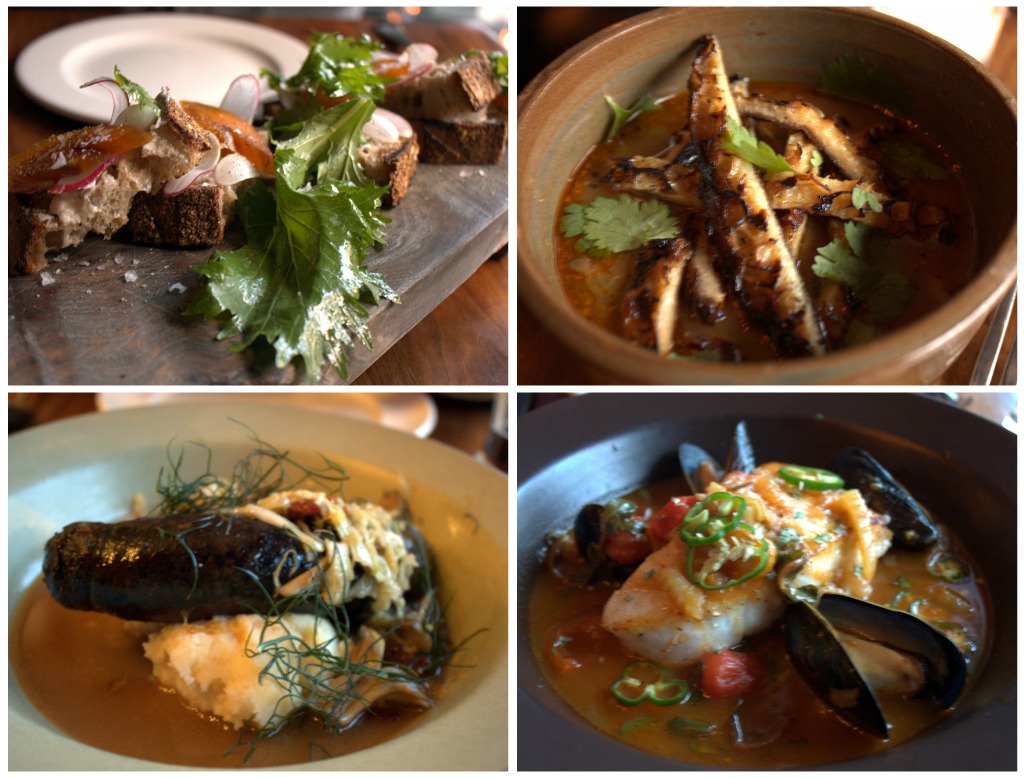
Bottarga, grilled bread, butter, radish. At first I thought the butter had been smoked Extebarri-style, the flavor was so prominent, but I think it was simply the heavily grilled bread. A simple open-faced sandwich was made special by the translucent slices of fish roe.

Grilled tripe, fennel, cabbage, coriander. This dish almost never came, but I wasn’t about to say, “oh, never mind” because I have a thing for cow’s stomach in all preparations and like to see how it’s handled in different cuisines. These tender strips were also given a serious grilling, and despite the presence of fennel and cabbage had a vague menudo quality thanks to a spicy broth and cilantro.
Kapusnica – smoked blood sausage, pickled cabbage, cherry, chili, hen of the woods. I’ll also always order blood sausage if I see it (I’ve never seen one quite this obscene) especially when paired with unusual mushrooms, a hit of spice and cherries (which I encountered time and again on this trip—you know you’re eating seasonally when the same ingredient shows up on your plate in numerous restaurants). The richness of the sausage still dominated, but wasn’t overly heavy.
Halaszle – Rock cod, Hungarian wax pepper, smoked broth, purslane, fennel, onion. Hmm…if they can smoke broth, maybe that butter was smoked, after all?

Bar Tartine * 561 Valencia St., San Francisco, CA


Benu

Possibly the strangest thing about Benu is that no one had any idea what I was talking about when I mentioned it (which was not that many times). Clearly, I do not fraternize with anyone particularly interested in French Laundry alumni. I could’ve just as easily said I was dining at Benihana for my birthday (the hibachi chain has been on my to-try list for some time).

The food at Benu is the style–seamlessly blending Chinese luxury ingredients with modern technique and a greenmarket sensibility–that I expect I might find in the more wealthy, aggressively image-conscious Asian capitals like Singapore or Hong Kong, but never encounter. Presentation is definitely important here, but never for the sake of showing off. The components are subtle and thoughtful.

I have resolved not to dork-out and take photos during higher-end meals, but the atmosphere while mildly stark, was not stuffy or nerve-jangling in a manner that I always associate with Corton. After settling into a relaxed (I was going to say quiet, but there was nothing hushed about the odd foursome next to us, what appeared to be married men showing off for married women who were less than impressed) corner table  I was glad that I had not left my camera in the hotel, after all.

To be perfectly frank, though, I don’t really enjoy blogging about tasting menus. Who cares what I have to say about 18 courses, wonderful as they may be? (In a similar vein, I’ve really started to tire of those talking head food tv shows where minor personalities ooh and ah over moijto ice pops or food truck fish and chips for people sitting at home on their couches.) After getting the play by play on the elaborate method used to craft the translucent kimchi wonton wrapper, I stopped focusing on techniques (well, the “shark’s fin” demanded a few questions—it’s made from Dungeness crab and hydrocolloids are involved) and took in the food at face value.

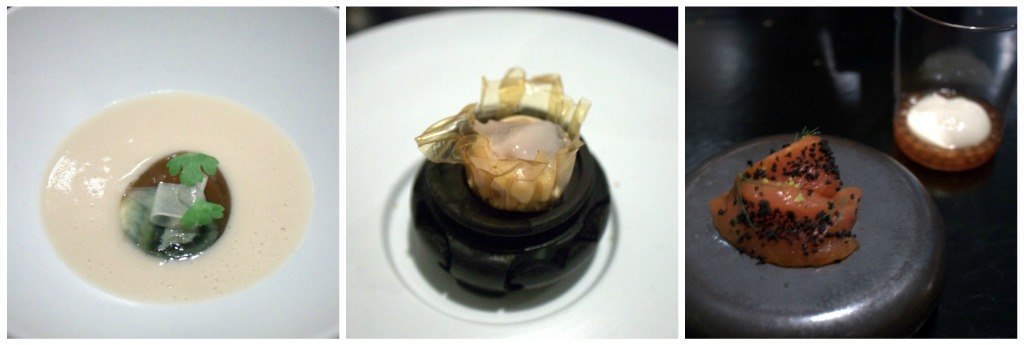
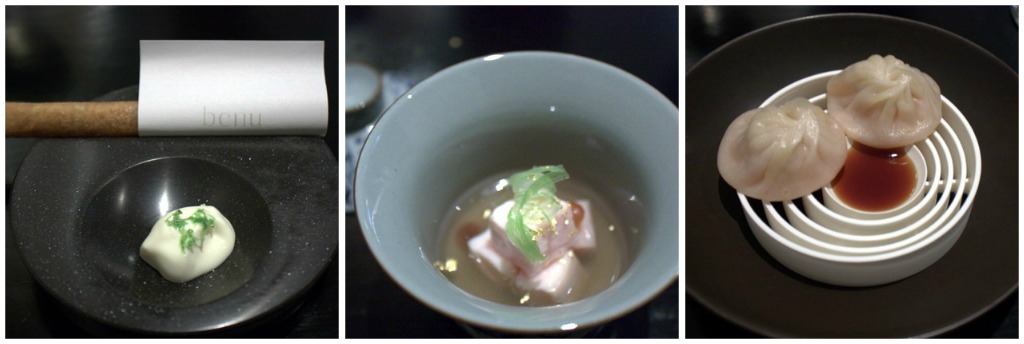
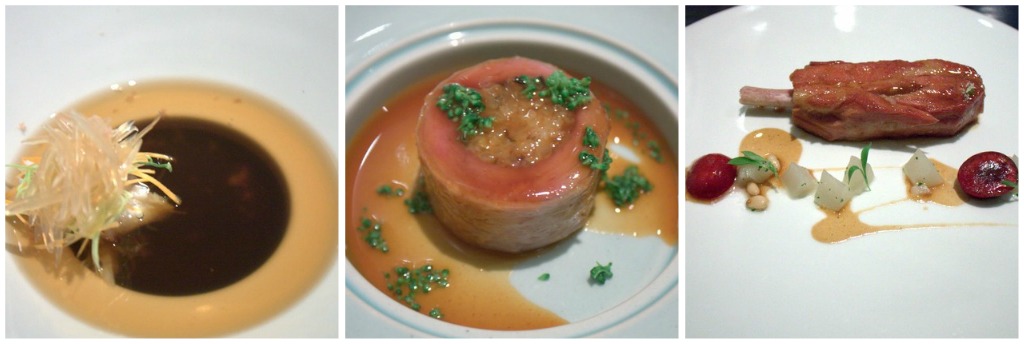
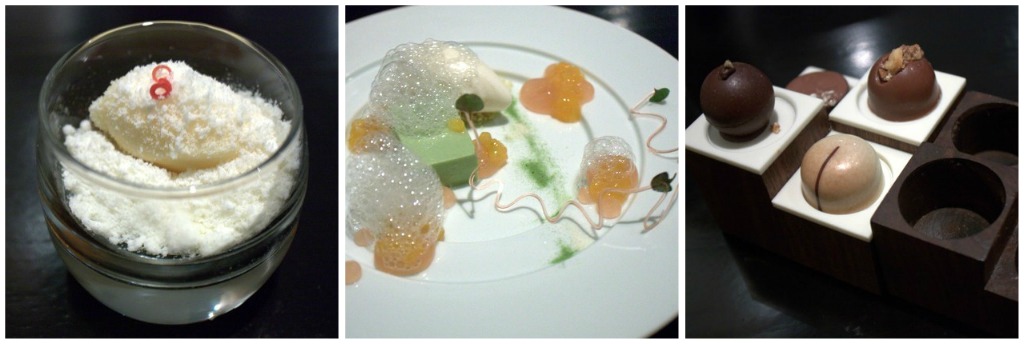
Continuing surface appreciations…here are photos without commentary. I can’t just let them flounder on flickr (do visit, if you would like to see full-sized images).

Benu1
thousand-year-old quail egg, cèpes, ginger
oyster, pork belly, kimchi
wild sockeye
    belly, maple-sake cure, fennel ash
    roe, homemade sesame tofu, Serrano chili

Benu2
cherry blossom, yogurt, cucumber, pistachio
beef tartare, caviar, horseradish, chive
tomato, hand-pulled mozzarella, dashi

Benu3
eel, feuille de brick, crème fraîche, lime
jasmine chicken with dates
foie gras xiao long bao

Benu4
monkfish liver torchon, turnip, plum, brioche
abalone, potato, caper, lettuce
fresh noodles, shrimp roe, tarragon, chicken jus

Benu5
“shark’s fin” soup, Dungeness crab, Junhua ham, black truffle custard
Duck, glutinous rice stuffing, fermented pepper
Pork rib, sunchoke, pine nut, cherry, black bean

Benu6
Passion fruit white chocolate, chili
Peach, matcha, elderflower
chocolates

Benu * 22 Hawthorne St., San Francisco,  CA


Char Burger

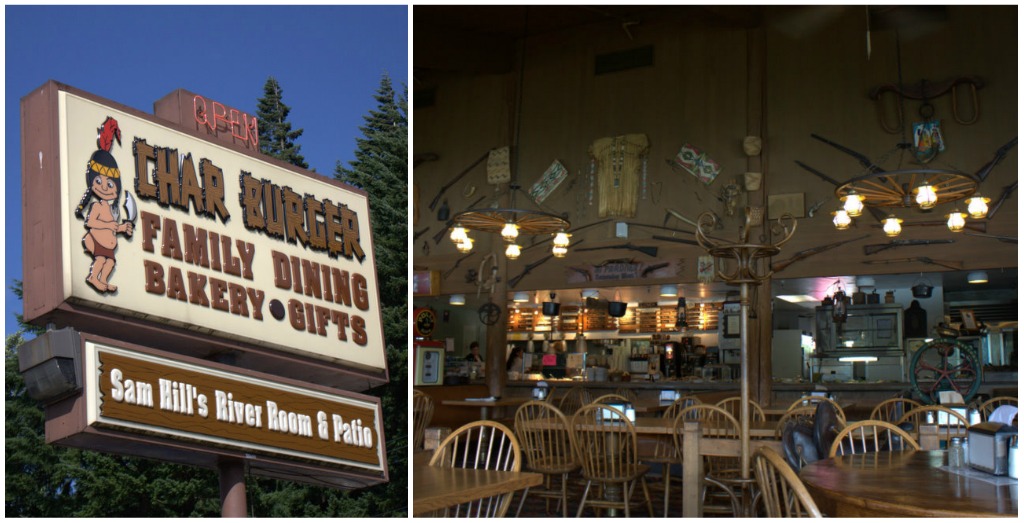
I wouldn’t exactly call Char Burger a institution. But anyone who grew up in an eastern suburb of Portland is probably familiar with the western-themed eatery that’s just beyond Multnomah Falls and the Bonneville Dam Fish Hatchery (those giant sturgeon freak me out as much now as they did when I was a kid) on the Oregon-Washington border.

Char burger sign2

With Girl Scouts, we’d often stop before crossing over on the Bridge of the Gods into Stevenson where Camp Arrowhead was. Sometimes, we’d stop at a soft serve place on the other side. I don’t remember a thing about that place, though. You do not easily forget Char Burger.

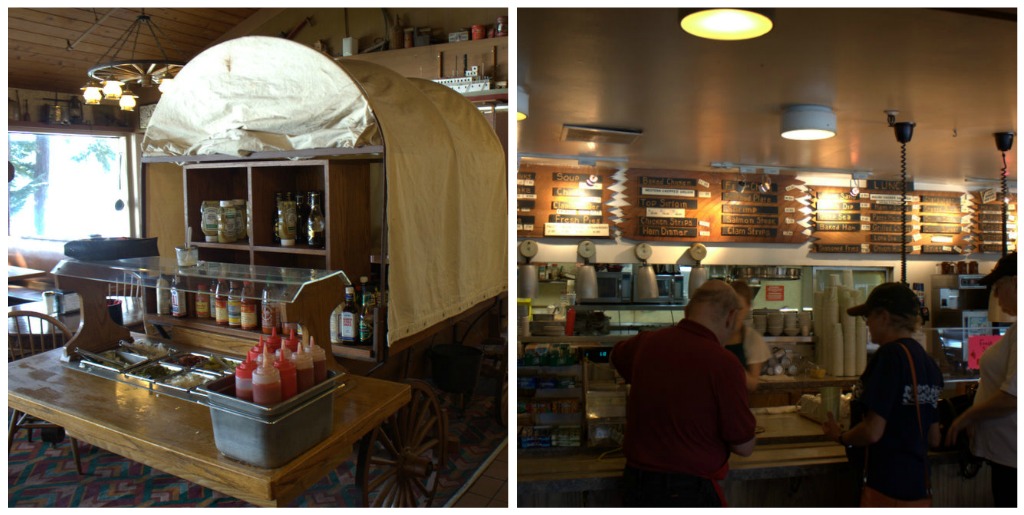
Char burger serving

Arrowheads and rifles plastered on the walls, wagon wheel light fixtures and a condiment station housed in a shrunken covered wagon make an impression. The food is simple and not remotely destination-worthy (when I told my friend Lema I was going, her initial reaction was “Why?” and then “You’re not going for the food, are you?”).  No matter, just line up, grab a try and order at the counter.

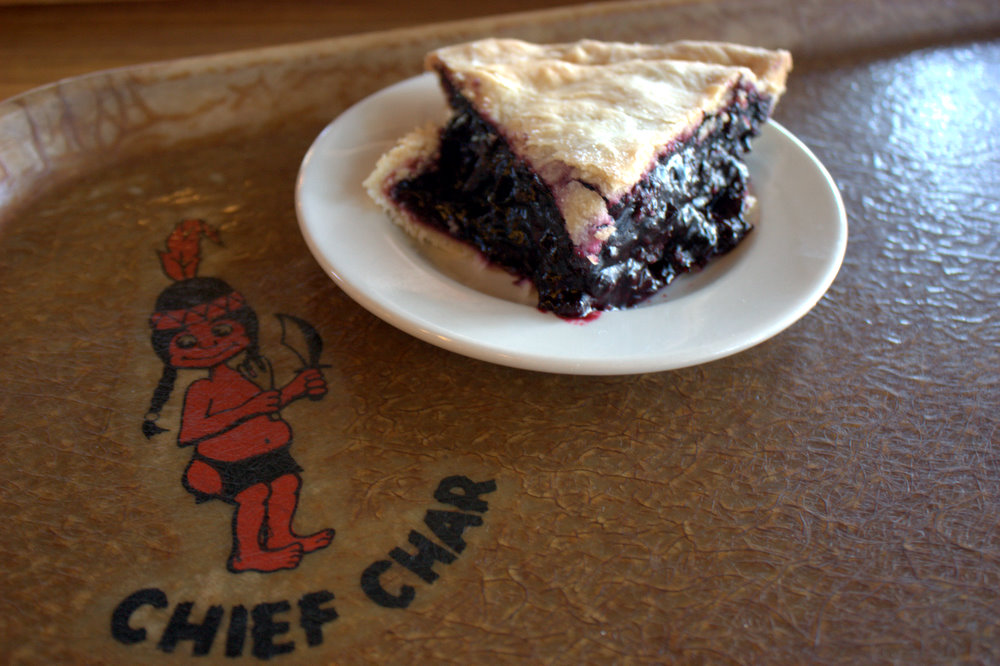
Char burger marionberry pie

I just had a slice of stiff marionberry pie and an unsweetened ice tea.

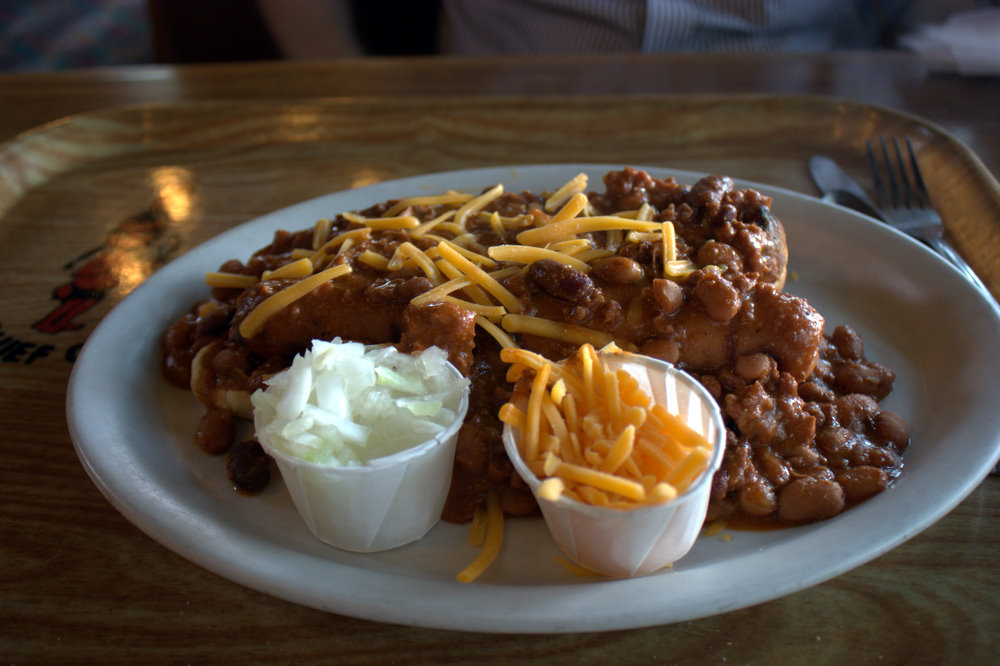
Char burger chili dog

A chili dog.

Char burger view

You do get a nice view of the Columbia River from the windows.

Char Burger * 745 Wanapa St., Cascade Locks, OR

Le Pigeon

After eventually giving in to the un-ignorable conviviality of the communal table (you can pretend neighbors seated two inches from you in NYC are invisible—or at least I do) it was surprising to discover that I was the only native Oregonian among the New Yorkers, New Jerseyites and Arizonans seated along the wall. (And in turn, just about anyone you might encounter in Portland who is under 35 and mildly hip is likely to be a transplant.) Is Le Pigeon for food pilgrims or do locals eat there too?

When the restaurant cleared after 10pm, my friend Todd who has been living in San Francisco for the past few years after a decades-long stint in Portland and was back in town for a visit, his last night, my first, the only date we had in common, my real birthday, popped in because he didn’t want to hang out at nearby Douglas Fir Lounge, our planned rendezvous, by himself. (Who would? I just wanted to see what it was like since I consider Doug Fir to be early New Portland, circa 2004, an era I missed by refusing to come back to Oregon for many years. It was a showcase of kind of informal bartending, lumberjack chic—in décor and the young patrons’ style—faux heshers and Japanese tourists with not inexpensive prices for straightforward drinks. It was the only place with a doorman and a required hand stamp—on a Monday night, no less.)

My point is that Todd had never been to Le Pigeon. “Too crowded and they don’t take reservations.” Sounds like me and my relationship to Prime Meats, Buttermilk Channel and Lucali, my neighbors I can never easily visit. Le Pigeon does take reservations now, by the way. And they’ve also removed the passive-aggressive “substitutions politely declined” tagline that vexed me on my 2009 visit (that's not why I didn't go–Le Pigeon was closed for Labor Day that particular week). Beast is still using it.

I was extremely lax about making notes, remembering menu details or taking tons of photos—it was a celebratory meal, after all, and the half-bottles of Riesling and Pinot Noir (Willamette Valley, of course) didn’t help boost my memory. The menu changes weekly (I would love to try the quail, peppers, tripe, potato chip I’m currently seeing) and I didn’t have the foresight to save a pdf.

Le pigeon dinner

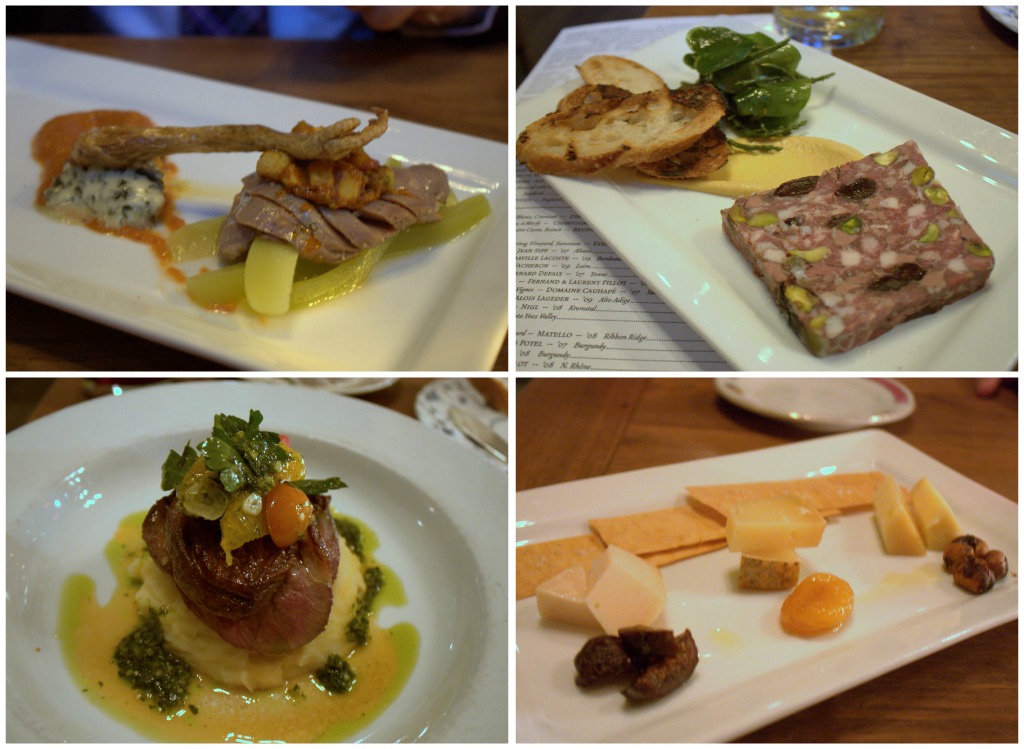
I had wondered if pigeon would be present and it was…both nearly raw and claw-on with edible bones. I hadn’t expected crudo, though technically it had been sous-vided for three minutes. Footed poultry appears to be a quirk not specific to NYC restaurants like Fedora and St. Anselm (they win, using the charred head too). Pickles and blue cheese were also present. Polenta? Even though this wasn’t my dish, from a visual perspective this was a fairly busy plate.

Boar terrine with pistachios and prunes was far more traditional. This was the first of two times that I would encounter sea beans in five days. A Portland trend? I would take sea beans over fiddleheads or nettles, any day.

My duck was also straightforward, at least visually. I know that I wouldn’t order something with tomatoes and pesto, so now I am remembering that cherries were on top and that the chunky, oil-bound greenery surrounding the potatoes had to have been made from pistachios.

Cheeses were not hyper-local, though it remained a western spread. I’m certain Montana was represented. Maybe even Idaho. I’m all for lesser-known regions (Tenpenny has been serving cheese from Utah). Hazelnuts, of course, couldn’t be more Oregonian. I do wonder if anyone calls them filberts anymore or if only old-timers like myself grew up using that name.

Le Pigeon * 738 Burnside St., Portland, OR

Pine State Biscuits

Read about the Reggie Deluxe, a massive biscuit sandwich I encountered while in Portland, over at Serious Eats. It was yesterday's sandwich in their ambitious Sandwich a Day coverage.

Taqueria Sinaloa & Flora

When I was in the Bay Area last September, I managed to squeeze in Laotian takeout in Oakland and that’s as much as I saw of Berkeley’s neighbor. This time, carless in San Francisco, I didn’t want to restrict myself to one land mass like  New York tourists who won’t branch out from Manhattan even if only for one meal (of course, they could also go to museums, shop or sit in parks, if they’d like). Luckily, my ‘90s teenage penpal Layla lives in Oakland and is now a grownup who was willing to pick James and I up at a BART station and squeeze in a bit of afternoon eating and drinking. (Also, her band The Wrong Words is playing in NYC this week—you should give them a listen.)

Oakland tacos

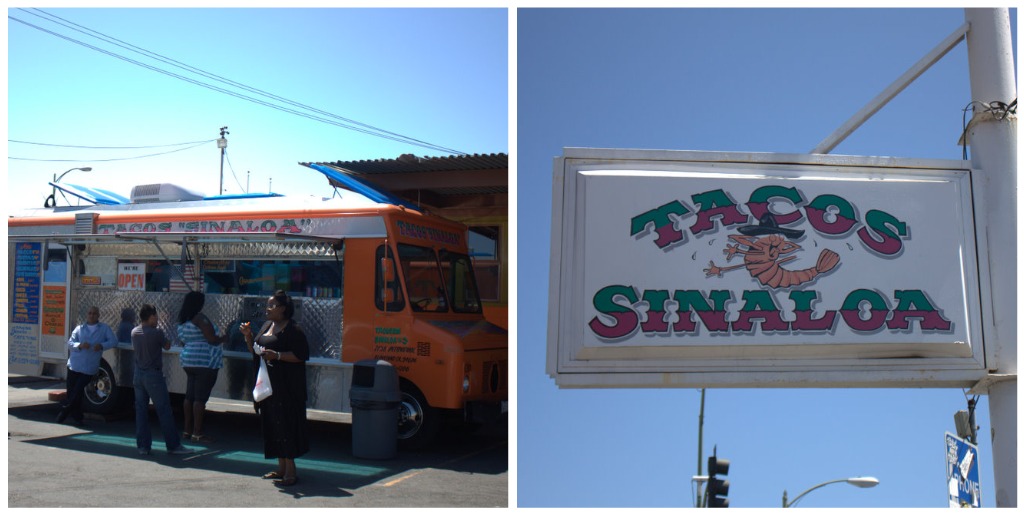
Taqueria Sinaloa was exactly the type of place I was looking for because it’s exactly the type of large-open-space, temperate-weather business—a whole corner with permanent outdoor seating for just two trucks?—you don’t see in NYC.

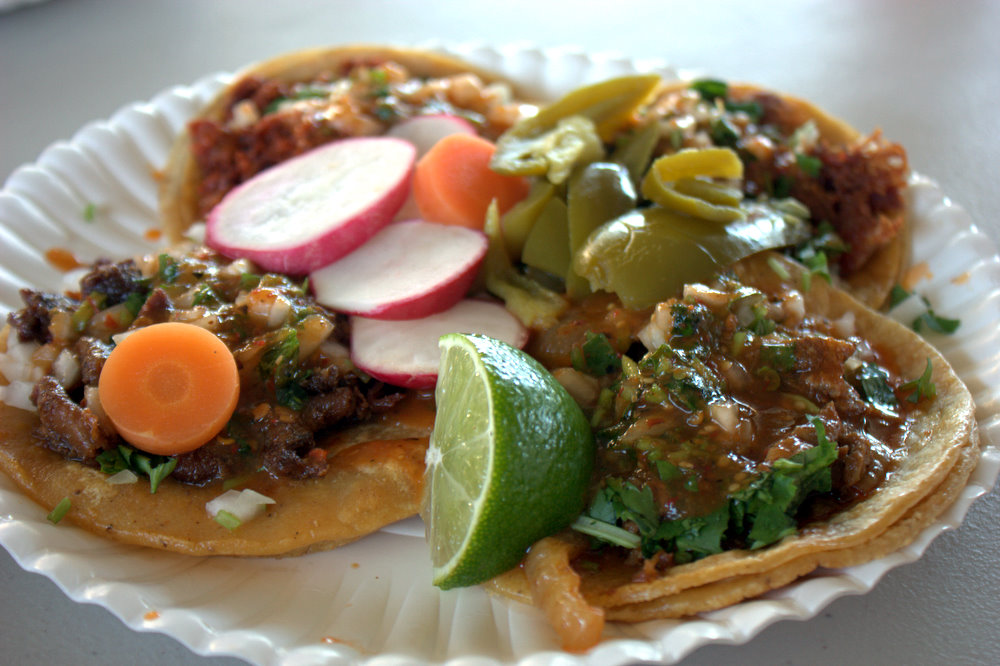
  Tacos sinaloa selection

I have been under the impression that tripa is tripe (that’s how it’s always translated here and stomach is definitely what I’ve been given) and that chinchulines are intestines (based only on meals eaten in Buenos Aires, which has nothing to do with Mexican food, granted) but at this truck, tripitas meant intestines. At $1.25, this specialty definitely had to be ordered, along with pastor and carnitas (so, I like pork).

The intestines turned out to be chopped into bits and were so tender and innocuous that you could serve a pile inside of tiny doubled-up corn tortillas to an organ meat hater and they could barely get mad at you. You would be hard pressed to pick out the tripitas from this foursome (it’s the lower left corner). I actually had been hoping for crispy-fried tubes like you see in Sichuan dishes. Which isn’t to say that these tacos were disappointing—they were very good.

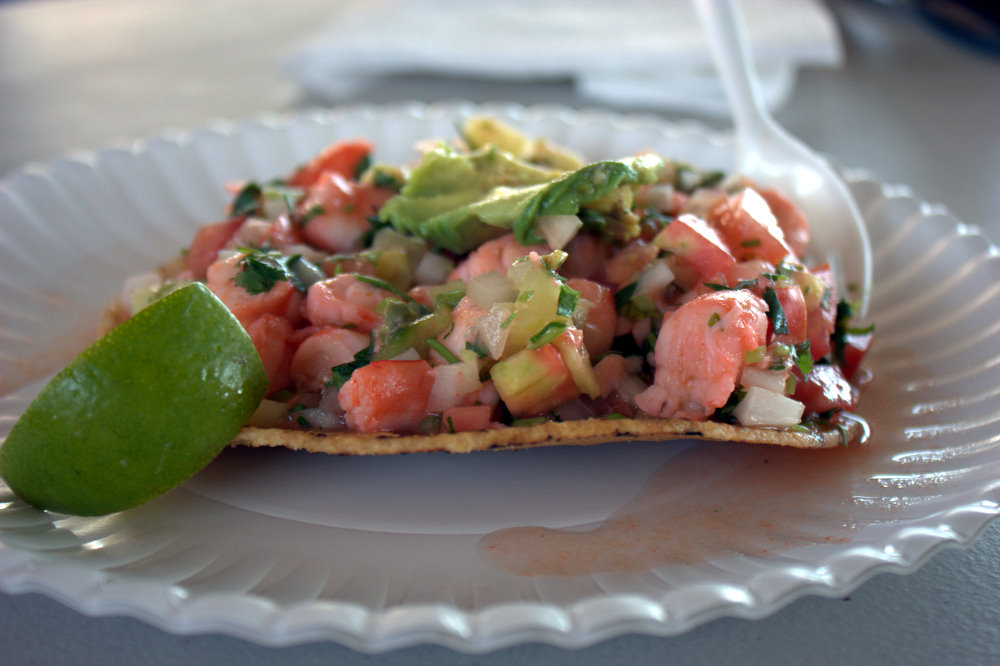
Ceviche tostada

Ceviche can also be had atop a tostada.

San Francisco and environs has an abundance of tiki, old-school and revival. Unfortunately, tiki isn’t an afternoon affair and we had to get back to San Francisco before Forbidden Island’s 5pm opening time. I opted for the Tonga Room instead (photos without commentary—the experience just ended up being too weird and frustrating to go into, but involved 20+ black Muslims, a Costco cake and a slew of rambunctious children forcing us out of our quiet corner of the bar by essentially surrounding us and taking over our table—more a fault of the server who sat them, not the celebrants) so we had a drink and shared a dessert at Flora, a deco brasserie downtown.

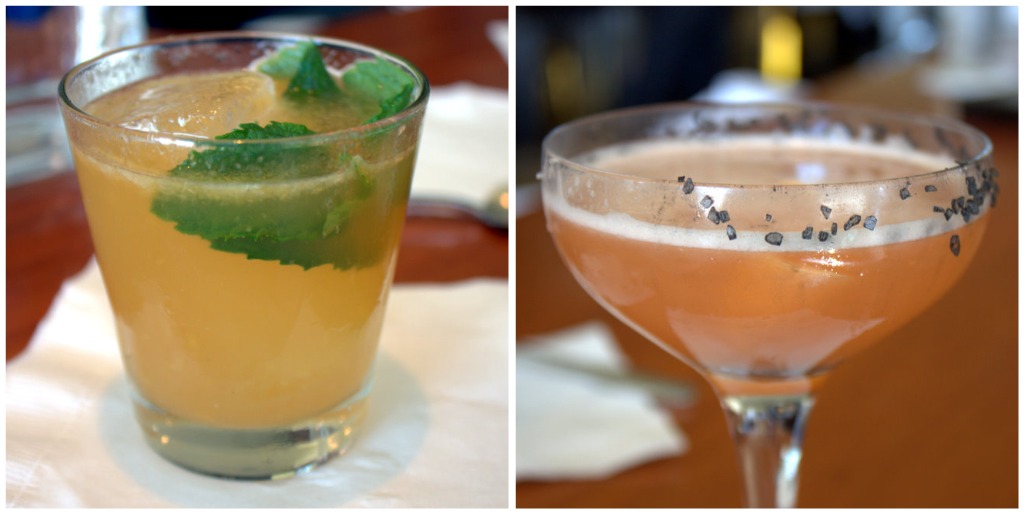
Flora cocktails
A Bulldog Smash (Bulleit bourbon, peach, mint, lemon, curaçao) was the perfect sunny day drink, never mind that you can barely get away with bare legs during Bay Area summers (not a complaint—I just wasn’t used to not sweating). The Salt & Pepper (Miller’s gin, grapefruit, lemon, Angostura bitters) was also refreshing—no actual pepper, just black salt.

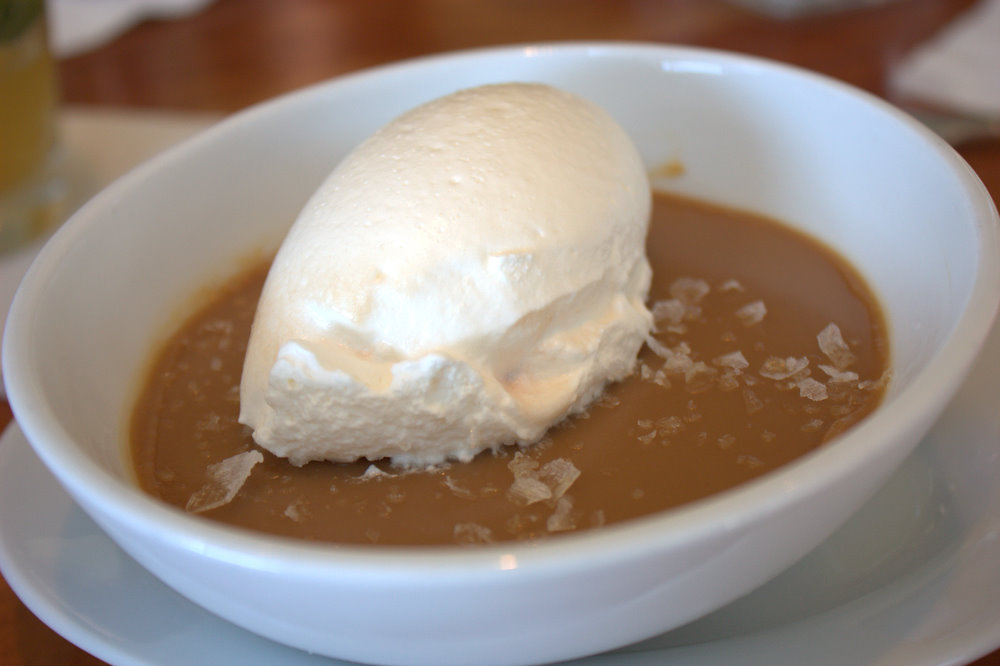
Flora salted caramel pudding

The whipped cream-topped caramel pudding with wonderful salt flakes nearly made up for not getting to Bi Rite for their salted caramel ice cream.

Taqueria Sinaloa * 2138 International Blvd., Oakland, CA

Flora * 1900 Telegraph Ave., Oakland, CA